Sylvanus Olympio: The First One They Shot, and the Family That Still Rules Togo
Remarkable Africans · The ones who went first
Sylvanus Olympio: The First One They Shot, and the Family That Still Rules Togo
Before Nigeria, before the Congo, before Ghana's own 1966, there was Lomé on a Sunday morning in January 1963. Togo's first president was found dead a metre from the gate of the American embassy, where he had gone to ask for asylum and had not been let in. It was the first successful coup against an independent African head of state. The sergeant who is widely believed to have fired went on to rule Togo for thirty-eight years, and his son runs it today.
We have written on this site about generals murdered in cars, prime ministers dissolved in acid, revolutionaries shot by their closest friends. All of it comes after Togo.
On 13 January 1963, in a small country most of the world could not place on a map, a handful of unemployed ex-soldiers killed a president and took a state. It was the first time in sub-Saharan Africa that a military coup had succeeded against an independent government, and the first time a head of state had been killed in the course of one.
Everything about the pattern was established that morning. The middle-of-the-night visit. The president who runs. The foreign embassy that does not open the gate. The exiles flown home to form a government within days. The international outrage that lasts about a fortnight.
And then the long silence, which in Togo's case has now lasted sixty-three years and is still going.
The man from Kpando
Sylvanus Épiphanio Kwami Olympio was born on 6 September 1902 at Kpando — a town that was then in German Togoland and is today in Ghana's Volta Region.
Hold that, because it explains most of what follows. The first president of Togo was born on what is now Ghanaian soil, to a people the borders would later cut in half.
The Olympios were an unusual family — Afro-Brazilian in origin, returnees, and by the early twentieth century among the wealthiest and most educated households on that coast. His uncle Octaviano Olympio was one of the richest men in Togo.
Sylvanus went to London at eighteen, and from 1922 studied at the London School of Economics under Harold Laski. He then studied law at Dijon and spent time in Vienna. He spoke English, French, German, Portuguese and Ewe.
He joined Lever Brothers and rose to run the African operations of what became Unilever — a Togolese man managing a European multinational's business across a continent in the 1930s, which tells you both how exceptional he was and how narrow the door had been.
During the war, the Vichy administration regarded the Olympios as pro-British. Sylvanus was arrested and held.
He was, by background, exactly the kind of man Europe said it wanted running an African country — and exactly the kind it could not tolerate once he started running one.
The border that cut a people in half
Togoland was German until the First World War. Britain and France took it and divided it between them; from 1922 the split was formalised under League of Nations mandate.
The line went straight through the Ewe.
Ewe villages, families and markets found themselves on two sides of an administrative boundary drawn in Europe. Some were in British Togoland, attached to the Gold Coast. Some were in French Togoland, which became Togo.
Olympio's entire early political career was about undoing this. He petitioned the United Nations repeatedly through the late 1940s and 1950s for Ewe reunification and for Togolese independence. He was, for a time, the most persistent African petitioner the UN had.
British Togoland votes in a UN-supervised plebiscite to join the Gold Coast. The following year the Gold Coast becomes Ghana, and the territory goes with it — including Kpando, where Olympio was born.
The Ewe were now split permanently between two independent African states rather than two European empires. Olympio's life's project had failed, and the failure was ratified by a vote.
He never fully accepted it. Neither did Kwame Nkrumah, from the other direction, who had ambitions of his own regarding Togo.
That unresolved quarrel is the second thing you need to understand about January 1963.
27 April 1960
Togo became independent. Olympio's party had swept the 1958 elections; he was prime minister, then president from 1961.
The country he took over was tiny, poor, and dependent. Its main export was phosphate. Its budget ran a deficit covered substantially by France. Its army numbered fewer than a thousand men.
Olympio's programme was austerity and independence, in that order. He cut spending hard. He refused to build a large army or a large presidential entourage. He kept his distance from both Cold War blocs and from the French community of states.
He also began asking the question that no head of a former French colony was supposed to ask out loud.
The currency
The CFA franc was created in 1945. After independence it remained — a currency issued under French supervision, with reserves held in Paris, covering the newly independent French African states.
Guinea had left it in 1960 under Sékou Touré, and France's intelligence service responded by flooding the Guinean economy with counterfeit notes. Mali left in 1962.
Olympio wanted out.
Togo formally establishes a national central bank.
He was negotiating with West Germany about a currency arrangement, with a German monetary adviser at his side, and there was discussion of pegging a Togolese currency to the Deutsche Mark. He also talked to Britain, to Ghana and to Nigeria about the possibility of a different monetary zone altogether.
He was killed thirty-two days after founding the bank.
Now the honest handling of this, because it is the most abused fact in the story.
You will read, on a great many websites, that Olympio was murdered two days before he was due in Paris to sign Togo out of the franc zone, and that France ordered it. That specific claim is asserted far more often than it is sourced, and we are not going to repeat it as fact.
What is documented: he created the central bank in December 1962, he was actively negotiating alternatives with several governments, and academic work on the episode shows the project faced serious obstacles — a substantial budget deficit and continuing dependence on French financial support — that make the neat two-days-before version implausible as it is usually told.
What is also documented: a French intelligence officer in Lomé had been lobbying on behalf of the demobilised soldiers for weeks before the coup, and French archives on the affair have never been fully opened.
The honest position is that Olympio's monetary ambitions gave France a strong motive, that French figures were in contact with the men who killed him, and that no document has surfaced showing Paris ordered it. That is less satisfying than the slogan. It is also what the evidence supports.
The men who did it
They were not ideologues. They were unemployed.
Several hundred Togolese had served in the French colonial army — in Indochina and in Algeria — and France had just demobilised them. They came home and asked to be taken into the Togolese army.
Olympio refused. The army had fewer than a thousand men; he did not want the cost, and he did not trust soldiers trained and paid by France.
It was a defensible decision and it was fatal.
The night of 12–13 January 1963
A commando of about six men moves on the presidential residence — a villa among pines, roughly a hundred and fifty metres from the Atlantic. Shooting is heard across Lomé as soldiers move to seize government buildings and arrest the cabinet.
Olympio gets out of the house. The United States embassy is close by. He crosses into the embassy grounds and waits — a head of state, in the dark, hoping the Americans will open a door.
Shots are heard outside the embassy.
The American ambassador, Leon B. Poullada, comes out and finds the president's body about three feet from the front gate of his embassy.
The soldiers' account was that Olympio had been challenged in the street, had resisted arrest, and had been shot in the struggle. Almost nobody has ever believed it. The consistent accounts describe him being shot at close range.
Eyadéma himself later claimed, publicly and more than once, that he was the man who fired.
Whether that claim was true or a piece of strongman self-mythology has been argued about for sixty years, and no proceeding has ever tested it.
A president died three feet outside a gate that stayed shut, and the man who said he pulled the trigger spent the next thirty-eight years as head of state.
The week after
The coup leaders did not attempt to govern themselves. Within days they brought home two of Olympio's exiled political opponents — Nicolas Grunitzky and Antoine Meatchi — and installed them as president and vice-president.
Grunitzky, as it happens, was Olympio's brother-in-law.
Africa reacted with real fury, and this is worth remembering precisely because it did not last.
Nkrumah's Ghana refused to recognise the new government. Julius Nyerere wrote to the United Nations arguing that the Togolese regime should be frozen out. When African heads of state gathered in Addis Ababa a few months later to found the Organisation of African Unity, the chair that would have been Olympio's was left empty.
An empty chair.
And then, within a year or two, everyone got on with it. Togo was readmitted to normal diplomatic life. No investigation was ever completed. Nobody was charged.
That is the actual lesson the 1960s absorbed. Not that a coup would be punished — that it would be condemned, and then accommodated.
Ghana's own turn came in February 1966, when Nkrumah was overthrown while flying to Hanoi. Nigeria's first coup came the month before. By the end of the decade the pattern was ordinary.
Was Ghana involved?
This is the part your Ghanaian readers will come for.
Grunitzky's government, and a good deal of contemporary comment, pointed at Nkrumah. The reasoning was straightforward: Nkrumah had territorial ambitions regarding Togo, the two men had been in open conflict, Togo had already accused Ghana of backing a rebellion against Olympio in 1962, and Togolese dissidents had found shelter in Accra.
Against that: Ghana was among the loudest voices refusing to recognise the coup government, which is a strange way to behave about your own operation.
The investigation was never completed. No evidence has ever been produced tying Nkrumah to the killing.
So the position is the same as with France. There was motive, there was hostility, there were contacts — and there is no proof. This article will not convert that into an accusation, in either direction.
What can be said without hesitation is that the quarrel between Accra and Lomé over a border drawn in Berlin made Olympio more isolated than a president of a small country could afford to be.
The uncomfortable part
Olympio was not a democrat in the way the martyrdom suggests, and a site that says so about Murtala Mohammed has to say it about him too.
By 1963 Togo was effectively a one-party state. Opposition parties had been squeezed out. Grunitzky and Meatchi were in exile because of him. Political prisoners were being held in Lomé — some, by contemporary accounts, in leg irons.
His austerity was genuine and it was unpopular with the people who had voted for him. He cut, and cut, and the cutting fell on the same southern constituency that had put him in office.
And the decision that killed him — refusing the demobilised soldiers — was not only about money. It read, in the north, as an Ewe president refusing to arm Kabyé men. Whatever his intent, that is how it landed, and the resentment it created was the fuel for everything that followed.
He was a serious, incorruptible, unusually capable man who was building an authoritarian state on the way to something better, and who ran out of time and allies simultaneously.
None of that makes shooting him at an embassy gate anything other than murder.
13 January 1967
Grunitzky's government lasted four years and never had authority. On 13 January 1967 — the fourth anniversary of the assassination, to the day — Eyadéma removed him and took power directly.
He chose the date. That was the point of it.
Gnassingbé Eyadéma ruled Togo until his death on 5 February 2005. Thirty-eight years. A single party, a personality cult, a security apparatus, and a long and well-documented record of repression.
On his death the army installed his son.
Togo's opposition calls the 2024 change a constitutional coup. Protests in Lomé in June 2025 were dispersed with tear gas and batons; people were killed and dozens arrested. Demonstrations have been banned in the country since 2022. Further protests continued through 2026.
The other family
And the Olympios did not disappear.
Gilchrist Olympio, Sylvanus's son, became the leading opponent of the Eyadéma regime, operating largely from exile — much of it in Ghana.
In September 1986 Eyadéma narrowly survived an attack in Lomé by a commando that had come in from Ghana, where Gilchrist was based.
In May 1992 Gilchrist Olympio was shot and seriously wounded on a road in provincial Togo. Human rights investigators concluded the attack was in all probability organised and carried out by the military.
So: the son of the murdered president, shot on a Togolese road twenty-nine years after his father, and surviving it.
In 2010, Gilchrist Olympio entered a political agreement with Faure Gnassingbé's government — a decision that split the Togolese opposition and that many of his own supporters have never forgiven.
Forty-seven years after the Gnassingbés killed his father, an Olympio sat down with them. Whatever you think of it, it is the point at which the vendetta stopped being the organising fact of Togolese politics — and the Gnassingbés were still in power at the end of it.
Why he belongs on this site
Because he was first, and because first matters.
Read the articles on this site about Mobutu, about Amin, about Murtala Mohammed, about Lumumba, and you will notice they share a structure so familiar that it reads as natural — as though this is simply how African politics worked in those decades.
It was not natural. It was learned. And it was learned in Lomé in January 1963, when a few dozen unemployed veterans discovered that a small group of armed men could take an African state, that the men who did it could keep it, and that the world would object for a season and then send an ambassador.
Between 1963 and the end of the 1980s there were dozens of successful coups in Africa. Olympio was the proof of concept.
And there is the second reason, which belongs to this website in particular: he is the man the borders broke. Born at Kpando, which is Ghana. President of Togo, which is not. He spent twenty years petitioning the United Nations to put the Ewe back together and he never managed it, and the border he fought is still there, and you can drive across it in an afternoon.
What remains
There is a boulevard in Lomé.
There is a monument at the place where he was found, near the gate that did not open.
There is a national holiday on 13 January that the Eyadéma regime redefined, for decades, as the anniversary of the 1967 takeover rather than the 1963 murder — the same date, made to mean the opposite thing.
There is no verdict, no inquiry, no charge, no finding. France's archives on the affair remain substantially closed. No investigation was ever completed. Not one person has ever been tried for the killing of Sylvanus Olympio.
And in Lomé, the government is run by the son of the man who said he did it.
Connected reading & sources
- The night Ghana went to war with Togo
- Thomas Sankara — the African revolution murdered by his best friend
- Murtala Mohammed — the Nigerian general murdered in his own car
- Mobutu Sese Seko — the man who killed African independence
- Idi Amin — the eight years that broke Uganda
- Omar Bongo — 42 years in power and the French system behind Gabon
- The long road to freedom — the leaders who paid the highest price
- Dr Kwame Nkrumah
- LSE — remembering sub-Saharan Africa's first military coup, fifty years on
- The Africa Report — who killed Sylvanus Olympio?
- African Economic History — Olympio, the CFA franc and monetary sovereignty, 1958–1963
- New Left Review — the franc zone
- Africanews — protests against the 2024 constitution, July 2026
Verified: 6 September 2026.
Checked against academic and journalistic accounts of the 1963 Togolese coup including LSE research commentary, reporting by The Africa Report, published scholarship on Olympio's monetary policy in African Economic History, work on the CFA franc including Pigeaud and Sylla, and contemporary reporting of Togolese politics by Africanews, Al Jazeera and the Associated Press. The dates of Olympio's birth on 6 September 1902 at Kpando, the 1956 British Togoland plebiscite, Togolese independence on 27 April 1960, the creation of a Togolese central bank on 12 December 1962, the coup and assassination of 13 January 1963, Eyadéma's takeover on 13 January 1967 and his death in February 2005, Faure Gnassingbé's accession in 2005 and his swearing-in as President of the Council of Ministers on 3 May 2025 are as recorded. Where the record is contested it is stated as contested: the widely repeated claim that Olympio was killed days before signing Togo out of the CFA franc zone is not established by the documentary record and is identified here as unproven; French and Ghanaian involvement in the coup have both been alleged and neither has been proven; the identity of the man who fired the fatal shots rests substantially on Gnassingbé Eyadéma's own later claims and has never been tested in any proceeding. No investigation into the assassination was ever completed and no person has ever been charged. This page makes no allegation against any living person.
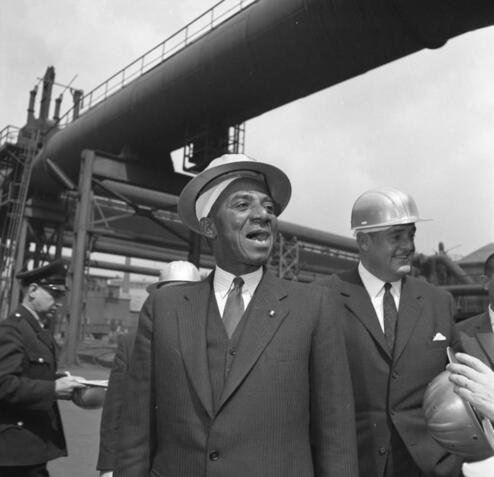
Header photo: Sylvanus Olympio in May 1961, during his visit to the Krupp factories in Essen.
Discover More
This remarkable story is only one chapter in the long and often forgotten history of Africa's connections with the wider world. Explore more articles on African kingdoms, Pan-African history, global cultural exchanges and the extraordinary individuals whose lives linked Africa with Europe, Asia and the Americas. Every story opens another door into Africa.