Shot, Poisoned, Shot: The Four Men Who Led Cameroon's Independence Movement
Remarkable Africans · The most dangerous job on the continent
Shot, Poisoned, Shot: The Four Men Who Led Cameroon's Independence Movement
One was shot in a forest in 1958 and buried in concrete so his grave could not become a shrine. One was poisoned with thallium in his aperitif at a Geneva restaurant in 1960, on the orders of a French prime minister. One was killed in the bush in 1966. And the last was shot in a market square in 1971, before forty thousand people summoned to watch, by Cameroonian soldiers under the command of a French officer — eleven years after independence.
There is a job that appears four times in this article, and it killed everyone who held it.
The office was Secretary-General of the **Union des Populations du Cameroun** — the UPC, the movement that campaigned for Cameroon's independence and reunification from 1948 onwards.
Four men held it in succession. A teacher-turned-clerk, a doctor, an economist and a schoolmaster.
Every one of them was killed.
And here is the part that ought to make this famous, and does not: **the killing did not stop at independence.** Cameroon became independent on 1 January 1960. Two of the four died afterwards. The last of them was executed in a public square in 1971, more than eleven years into the life of the sovereign republic — by an independent African government, with a French officer commanding the firing squad.
What the UPC actually was
Founded in 1948, the UPC wanted two things: **independence from France, and the reunification** of the two Cameroons that Britain and France had divided between them after the First World War.
It was not, at the outset, an armed movement. It was a mass political party with trade union roots, and it had one advantage almost no other African movement possessed.
Cameroon was a **United Nations trust territory**, not an ordinary colony. That gave the UPC a legal right to petition the United Nations directly — and it used it.
France's difficulty was never that the UPC was violent. It was that the UPC was popular, and legally in the right.
On 13 July 1955 France banned it. Everything after follows from that date.
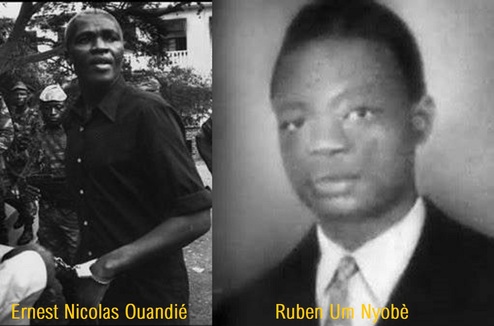
One · Ruben Um Nyobè
The clerk who argued at the United Nations
Um Nyobè was a former court clerk and trade unionist from Boumnyebel, a Bassa, and by every account one of the most effective political organisers anywhere in colonial Africa.
He travelled to New York and addressed the Fourth Committee of the UN General Assembly in **1952, 1953 and 1954**, demanding a timetable for independence. He was calm, exact, and very hard to answer.
When the party was banned in 1955 he went into the forest of his home region and organised from there.
France set out to find him. It built, for the purpose, a full counter-insurgency system: zones of pacification, the forced resettlement of whole districts into guarded camps, aerial bombardment, torture as routine practice, and forged broadcasts to split the movement.
His hiding place was located after companions were captured and tortured until some of them talked.
Um Nyobè is shot near his native village by auxiliaries under the command of a French officer. He is forty-five. Witnesses describe more than fifteen bullets. His autopsy is never published.
His body was displayed publicly, and then **buried in concrete**, specifically so that the grave could not become a place of pilgrimage.
Then his name was banned. For decades Cameroonians could not say it aloud in public.
The French military archives covering the operation of 13 September 1958 remain classified to this day.
Two · Félix-Roland Moumié
The doctor poisoned in a Swiss restaurant
Moumié was born on 1 November 1925 at Foumban, the son of a Protestant evangelist. He trained as a physician. He took over the UPC on the day Um Nyobè died — 13 September 1958 — and led it from exile.
By 1960 he was operating out of Accra and Conakry, and he was the most visible anti-colonial Cameroonian voice in the world.
Cameroon became independent on 1 January 1960 under Ahmadou Ahidjo, France's preferred candidate. Moumié denounced the arrangement as a transfer of form without substance.
According to the French intelligence literature, the decision to remove him was taken by the **Prime Minister, Michel Debré**, who tasked his adviser **Constantin Melnik**, who in turn went to **Jacques Foccart** — de Gaulle's Africa man, the architect of the network known as Françafrique.
The operation was designated *homo*. For homicide.
The man sent was **William Bechtel**, a reservist of the SDECE, France's external intelligence service. He had been a member of the Free French in London in 1940 and a hero of the Resistance. He presented himself to Moumié as a journalist sympathetic to anti-colonial causes, using the name Claude Bonnet, and had already approached him once in Ghana.
Moumié trusted him.
Four people — Moumié, Bechtel, a woman and another man — dine at the Plat d'Argent, a smart restaurant in the old town of Geneva. Bechtel puts thallium, an odourless and tasteless rat poison, into Moumié's pastis.
Moumié wakes with stomach pain, then chills and partial paralysis. He is a doctor. He tells the hospital staff he believes he has been poisoned, and remembers that one of the three pastis had tasted wrong.
After nearly three weeks of agony, Félix-Roland Moumié dies in a Geneva hospital. He is thirty-five.
The plan, reportedly, had been for him to die slowly and far away in Conakry, so that it would look like illness. He swallowed too much and died in Switzerland instead — which is the only reason there was ever an investigation.
And there was almost no investigation.
The Geneva police did not open their inquiry until 31 October — more than a fortnight after the poisoning, and too late to question Moumié while he was still able to speak.
Traces of thallium were later found in Bechtel's jacket pocket.
He was arrested, and released on bail of ten thousand Swiss francs, raised — according to his own lawyer — by dozens of anonymous donors.
The Swiss case was dismissed. Bechtel was never convicted of anything.
Days after the death, Ernest Ouandié gave an interview to Swiss television saying that the French government bore a heavy responsibility and that this was where one should look.
**The interview was censored.**
Moumié's widow, Marthe Ekemeyong Moumié, spent the rest of her life pursuing the case.
Three · Osendé Afana
The economist
Castor Osendé Afana was the first Cameroonian to earn a doctorate in economics in France. He was a serious scholar of underdevelopment, and he wrote about the economic architecture that keeps a nominally independent country dependent.
He returned to fight, opened a southern front, and was **killed in 1966**.
He is the least remembered of the four and the one whose analysis has aged best, because what he wrote about — political independence without economic sovereignty — is the subject of half the pages on this website.
Four · Ernest Ouandié
The schoolteacher, and the market square
Ouandié was born in 1924 at Badoumla in Bana district, in the Bamileke west. He qualified as a teacher in 1943 and taught in public schools before politics took him.
After Moumié's death he became head of the UPC.
On 1 May 1961 a military tribunal in Yaoundé sentenced him, and Abel Kingué in absentia, to deportation. That same year **he secretly returned from Accra into Cameroon** — into a country where the government had a French-trained army, and where being him was a capital matter — to continue the fight.
He stayed in the *maquis* for nine years.
Abel Kingué died in Cairo on 16 June 1964, leaving Ouandié the last surviving member of the original leadership. President Ahidjo declared him **public enemy number one**.
In August 1970 the last UPC formation was taken and Ouandié surrendered at the gendarmerie post at Mbanga.
The trial
He was tried by a military court on charges of rebellion and of seeking to overthrow a lawful government by violence.
**He was tried without counsel** — because his French lawyers, who according to the published accounts included the future French president François Mitterrand, were refused entry into Cameroon by Ahidjo's government.
He was sentenced to death.
Tried with him was **Bishop Albert Ndongmo**, the Catholic Bishop of Nkongsamba, accused of complicity. The bishop was also sentenced to death; Ahidjo commuted it to life imprisonment and sent him to the camp at Tcholliré. He was pardoned in 1976 on condition that he leave the country.
15 January 1971
Three men were executed that afternoon in the main public square at Bafoussam: **Ernest Ouandié**, **Raphaël Fotsing**, and **Gabriel Tabeu**, known as Wambo le Courant.
Roughly **forty thousand people had been summoned to attend.** The government intended it as an exemplary punishment — a public demonstration, staged in the heart of the region that had resisted longest.
The three were tied to posts. The first two fell first.
Ouandié **refused to be blindfolded.** There was an argument with the authorities about it, in front of the crowd, and he won it. They let him face the guns.
He took twelve bullets, at 4:16 in the afternoon. As he fell he called out that others would continue the struggle.
The firing squad was made up of Cameroonian soldiers. It was **commanded by a French army officer**, who after Ouandié had already gone down walked over and delivered the coup de grâce to his head with a pistol.
He was forty-six or forty-seven years old.
The country had been independent for eleven years and fifteen days.
The pattern, stated plainly
Two of the four were killed before independence, by France. Two were killed after it, by an independent African government advised, trained and in one case personally commanded by France.
That is what the word *independence* meant in this country, and it is why the Cameroon page on this site is titled the way it is.
1991: the year Cameroon did both things
Twenty years after Bafoussam, something happened that captures the whole relationship a country can have with its own past.
On the weekend of the twentieth anniversary, opposition groups plan to lay flowers at the spot in Bafoussam where Ouandié was shot. The Governor of Western Province issues a communiqué telling people to stay at home. Troops are put on alert. Security is reinforced around the execution site. When crowds gather anyway, the security forces disperse them, seize the bouquets, and take some of those present to the Governor's office for interrogation.
Ernest Ouandié is proclaimed a **national hero** of Cameroon.
He is formally rehabilitated by law.
Flowers confiscated in January. National hero in June. Rehabilitated in December.
The same government, the same year.
And the 1991 law that restored Um Nyobè, Moumié and Ouandié as national heroes **also rehabilitated Ahmadou Ahidjo** — the president who had hunted them, tried Ouandié without a lawyer and signed the order for the market square.
That is Cameroon's settlement with its own history. Everyone is a hero. Nobody is responsible.
What France has and has not done
In 2005 a French parliamentary mission used the phrase *zones of mass atrocities* about Cameroon. There was no judicial follow-up.
In recent years, under a French policy of examining colonial memory, historians working with access to French archives have produced a detailed account of the Geneva poisoning — naming Bechtel, describing the restaurant, the pastis and the thallium, and placing the decision with the office of the Prime Minister.
That is a real advance and it should be acknowledged.
What has not happened: no French government has formally recognised the conflict in Cameroon as a war. Nobody has been prosecuted for Um Nyobè, for Moumié, for Afana or for Ouandié. **The military archives on the operation that killed Um Nyobè in September 1958 remain closed.** William Bechtel died without ever facing a verdict.
Compare this with Algeria, where France has at least issued specific acknowledgements about specific killings.
Cameroon has a parliamentary phrase, a historians' report, and a sealed file.
Why this belongs on this site
Because almost everything about it is unknown outside Cameroon, and because the mechanism is visible in a way it rarely is.
Most colonial violence is diffuse — a policy, a system, a statistic. Here it is four named men, four dates, four methods, and in three of the four cases a documented chain of command running back to a French minister's desk.
A clerk who argued at the United Nations. A doctor. An economist. A schoolteacher.
Not one of them was a warlord. Not one of them ever governed anything. They held an office in a political party, and holding it killed them.
And the last of them died in 1971 — the year Idi Amin took Uganda, two years before Mobutu renamed the Congo, sixteen years before Sankara was shot in Ouagadougou.
By then Cameroon had been independent for over a decade, and France was still commanding the firing squad.
What remains
There is a monument at Éséka to a man whose grave was sealed in concrete precisely so that there would be no monument.
There is a building at 4, Grand-Rue in the old town of Geneva, and a restaurant nearby where a doctor drank a poisoned pastis in October 1960.
There is a bail receipt for ten thousand Swiss francs, paid by anonymous donors, and a dismissal.
There is a square in Bafoussam where forty thousand people were required to stand and watch, and where twenty years later the police took the flowers away.
There is a French file, still closed, on 13 September 1958.
And there is Ernestine Ouandié, who was a small child when her father was shot, who took a degree in journalism, moved to Cameroon in 1986 specifically to find out who he had been, and later served on her country's National Commission on Human Rights and Freedoms.
She spent her working life on the second half of what he shouted in the square.
Connected reading & sources
- Cameroon — The War France Denied for Fifty Years — the full country history
- Patrice Lumumba — the same years, the same methods, the next country
- Sylvanus Olympio — Togo, 1963
- Thomas Sankara — Burkina Faso, 1987
- Jacqueline Moudeina — the one case where somebody was finally convicted
- Algeria — The Unbreakable Path to Freedom — where France used the methods it developed in Cameroon
- Félix-Roland Moumié — biography and the thallium poisoning
- Tribune de Genève — the Geneva poisoning, detailed at last
- Cairn.info — Le renseignement français en 100 dates: the SDECE poisoning of Félix Moumié
- Jeune Afrique — 3 November 1960, the death of Félix Moumié
- Ernest Ouandié — trial, execution and rehabilitation
- African Heritage — Ernest Ouandié, hero and martyr
- JusticeInfo — Um Nyobè, hero and symbol of French colonial crimes
Verified: 10 September 2026.
Checked against the sources listed above, including French intelligence historiography, Swiss press reporting on the Geneva investigation, and published biographies. The founding of the UPC in 1948, its banning on 13 July 1955, Ruben Um Nyobè's petitions to the United Nations in 1952, 1953 and 1954, his killing on 13 September 1958 and the sealing of his grave, Félix-Roland Moumié's succession to the leadership on the same date, the dinner at the Plat d'Argent in Geneva on 15 October 1960 and his death on 3 November 1960 aged thirty-five, the killing of Osendé Afana in 1966, the death of Abel Kingué in Cairo on 16 June 1964, Ernest Ouandié's surrender at Mbanga in August 1970, his trial without counsel, the trial and commuted death sentence of Bishop Albert Ndongmo, the public execution of Ouandié, Raphaël Fotsing and Gabriel Tabeu at Bafoussam on 15 January 1971, the events at the execution site in January 1991 and Ouandié's proclamation as a national hero on 27 June 1991 and rehabilitation on 16 December 1991 are as recorded. Where accounts differ, the disagreement is noted rather than resolved: the date of the poisoning is variously given as 13 and 15 October 1960 and Moumié's death as 3 and 4 November 1960; the size of the crowd at Bafoussam is generally reported as around forty thousand and is an estimate. Attribution of the Moumié assassination to William Bechtel of the SDECE, acting on a decision taken at the level of the French Prime Minister and transmitted through Constantin Melnik and Jacques Foccart, follows the published French intelligence historiography and Swiss investigative reporting; Bechtel was arrested, released on bail and the Swiss case against him was dismissed, and he was never convicted of any offence. No French government has formally recognised the conflict in Cameroon as a war, and the French military archives covering the operation of 13 September 1958 remain classified. No casualty figures for the wider conflict are given on this page. This page makes no allegation against any living person.
"History will tell; Let the fight be continued by others.
Long live (God bless) Cameroon."
Ernest Nicolas Ouandié (1924 – 15 January 1971)
Discover More
This remarkable story is only one chapter in the long and often forgotten history of Africa's connections with the wider world. Explore more articles on African kingdoms, Pan-African history, global cultural exchanges and the extraordinary individuals whose lives linked Africa with Europe, Asia and the Americas. Every story opens another door into Africa.