Omar Bongo: 42 Years in Power and the French System Behind Gabon
Remarkable Africans · The ones who learned how power works
Omar Bongo: 42 Years in Power and the French System Behind Gabon
He survived a coup, inherited the presidency, ruled Gabon for forty-two years, presided over an oil-rich state and became one of the most important figures in Françafrique. He was not Mobutu. He was not Idi Amin. He rarely needed to be. Bongo mastered something more durable: keeping the opposition close, the money moving, France interested and himself indispensable.
There are African presidents whose stories are easy to tell.
The murderer. The madman. The thief. The military dictator. The man with the palace while his people starved.
Omar Bongo is harder.
He ruled Gabon from 1967 until his death in 2009. Forty-two years. During that time he turned a small, oil-rich former French colony into one of the central pieces of the French political network in Africa.
He was authoritarian. He presided over a one-party state for more than two decades. His opponents accused his government of electoral manipulation, corruption and repression. His name appeared repeatedly around some of the most extraordinary financial investigations in modern French politics.
But he also kept Gabon out of the devastating civil wars that consumed several neighbouring countries. He negotiated with opponents. He brought rivals into government. He helped build infrastructure. And when the political winds changed in 1990, he did something many African rulers of his generation refused to do: he opened the political system.
Then he won anyway.
The remarkable thing about Omar Bongo was not that he refused to change. It was that he learned how to change without giving up power.
The country France did not want to lose
Gabon became independent from France on 17 August 1960.
It was a tiny country by African standards, with a population measured in millions rather than tens of millions. But beneath its forests were resources that made it strategically valuable: petroleum, manganese, timber and uranium.
France had no intention of simply walking away.
Across its former African empire, Paris constructed a relationship that later became known as Françafrique — a mixture of diplomacy, business, military agreements, intelligence relationships and personal networks through which France retained enormous influence after formal colonial rule had ended.
Gabon became one of the most important examples.
The oil company Elf-Aquitaine, then closely connected to the French state, became deeply involved in Gabonese petroleum. French companies wanted access to resources. French governments wanted a dependable ally. Gabon's presidents wanted protection, investment and political support.
The arrangement was extraordinarily durable.
The bargain was simple.
Gabon remained friendly to France. French economic interests remained deeply embedded in Gabon. Paris retained a privileged position. And the man running the country acquired something every ruler values: powerful friends outside his own borders.
February 1964: the soldiers come
Before Bongo became president, Gabon experienced a coup.
On 18 February 1964, Gabonese military officers overthrew President Léon M'ba in a largely bloodless coup. They wanted former foreign minister Jean-Hilaire Aubame to replace him.
Omar Bongo was already inside the system. He was a senior member of M'ba's presidential machinery and was caught up in the coup.
France reacted immediately.
French troops landed in Gabon and restored M'ba to power the following day.
There is no serious argument about the central fact: France used military force to restore the sitting Gabonese president.
The intervention mattered enormously for Bongo.
He had seen first-hand what French power meant. And Paris had seen him.
The young Gabonese politician had survived the country's only successful attempt to overthrow its government during the twentieth century. Three years later, the man France had helped restore would be dead — and the young man who had been inside his political machine would become president.
The succession was prepared
Léon M'ba's health was deteriorating badly.
In 1966, the constitution was changed to create the position of vice-president, with the vice-president designated to succeed the president if the presidency became vacant.
Albert-Bernard Bongo was chosen.
He was elected vice-president alongside M'ba in March 1967.
M'ba died later that year.
Bongo became president.
Gabon becomes independent from France. Léon M'ba becomes the country's first president.
Military officers overthrow M'ba. French troops intervene and restore him to power.
A constitutional change creates a vice-presidential succession mechanism. Bongo becomes vice-president.
Following M'ba's death, Albert-Bernard Bongo becomes president of Gabon.
The man who had been rescued by France in 1964 was gone.
The man who had watched France rescue him was now running the country.
One party
Bongo moved quickly.
In 1968 he transformed Gabon into a one-party state and created the Parti démocratique gabonais — the PDG.
For more than two decades, the PDG dominated Gabonese political life.
There were elections. There were institutions. There were parliamentarians.
But there was no meaningful competition for the presidency.
Bongo was not interested in repeatedly risking the whole system by allowing an opponent to build an independent political machine strong enough to remove him.
Instead, the PDG became the political skeleton of the state.
Government jobs, contracts, access and political influence ran through the system.
And then came the oil.
The oil changes everything
Gabon became an oil producer in the 1960s. Production and revenues expanded dramatically during the oil boom of the 1970s.
Suddenly a country of very small population had enormous resources per head.
Libreville grew.
Roads and infrastructure were built.
The Transgabonais railway eventually connected the interior to the coast and became one of the country's most important pieces of infrastructure.
For ordinary Gabonese people, the oil era could therefore look like progress.
And in some respects it was.
The problem was not simply that money existed.
The problem was who controlled it.
The man who learned to buy loyalty
Bongo's political style was different from that of Mobutu.
Mobutu cultivated fear and spectacle.
Bongo cultivated relationships.
He became extraordinarily skilled at making people useful to him — and making himself useful to them.
Opposition politicians could be brought into government. Former rivals could receive appointments. Political factions could be divided. Business interests could be accommodated.
It was not necessarily necessary to destroy an opponent if you could make him part of the system.
That became one of Bongo's great political talents.
He did not have to make every enemy disappear. He only had to make enough enemies decide that staying was more profitable than fighting.
Françafrique
This is where the Bongo story becomes much bigger than Gabon.
Bongo became one of the most important African figures in the French political network known as Françafrique.
Jacques Foccart, Charles de Gaulle's powerful adviser on African affairs, was one of the central figures in this system.
France wanted friendly governments in its former colonies. Those governments wanted French diplomatic and military backing.
Gabon was an ideal partner.
It was resource-rich. It was politically stable. It was strategically positioned. It was friendly to France.
And Bongo became extraordinarily well connected in Paris.
French presidents from different political camps knew him.
He cultivated relationships with presidents, ministers, businessmen and political operators.
His influence eventually reached far beyond Gabon.
That is the uncomfortable point about Françafrique: it was not simply France controlling Africans. It was a network in which African presidents could also acquire influence in France by controlling access to African resources.
Then Eva Joly started asking questions
In 1994, French investigating magistrate Eva Joly began investigating financial irregularities surrounding the French oil giant Elf-Aquitaine.
What emerged became one of the biggest political-financial scandals in modern French history.
Elf had operated throughout Africa and maintained extraordinary relationships with African political leaders.
The investigation uncovered secret commissions, offshore companies, Swiss bank accounts and enormous flows of money.
And Omar Bongo's name kept appearing.
So did the name of André Tarallo, Elf's powerful Africa specialist and longtime figure in the company's Gabon operations.
French investigators examined money connected with Gabon, Elf and political networks in France.
The scale was enormous.
But here we need to be precise.
Bongo was repeatedly identified in investigative reporting and judicial material as a beneficiary or intended beneficiary of financial arrangements surrounding Elf. He was never prosecuted in the major Elf trial itself. He also denied receiving Elf commissions directly, arguing that payments were made to the Gabonese state rather than to him personally.
The Elf investigation nevertheless established that a vast clandestine financial system existed around the company, African political relationships and French politics. Several senior Elf executives were convicted.
This distinction matters.
It is easy to write that Bongo was "convicted of stealing Elf money."
That would be false.
The documented story is more complicated — and more interesting.
Investigators uncovered a system in which African oil money, French business interests and political financing became entangled. Bongo was repeatedly named in that world. The French political establishment itself was implicated in the broader system.
That is Françafrique without the polite language.
The money went both ways
The most extraordinary part of the Elf affair was that the money did not simply disappear into Africa.
It could travel in the opposite direction.
African oil money helped finance relationships inside French politics.
Senior French political figures and parties were connected to a system of secret financing surrounding Elf.
Former Elf chairman Loïk Le Floch-Prigent described the mechanism during the trial in remarkably direct terms: money went out through Africa and returned to France.
In other words, the former colonies were not merely sources of raw materials.
They could become sources of political money.
The colonial flag had gone. The financial relationship had not.
Gabon gets angry
Bongo did not quietly accept the investigations.
When Swiss authorities froze accounts connected to companies suspected of holding Gabonese or Bongo-related funds, the Gabonese government protested strongly.
Bongo invoked national sovereignty.
And he had a point worth considering.
Why should a French judge effectively investigate the financial affairs of the president of an independent African state?
But there was another question underneath it:
Why were the financial structures of an ostensibly independent African state so deeply entangled with the former colonial power in the first place?
The palaces and the people
Bongo's personal wealth became legendary.
He and members of his family acquired extensive property in France, particularly in Paris.
French investigations later examined an extraordinary collection of luxury real estate associated with the Bongo family and other African leaders.
Again, the details matter more than the mythology.
This was not simply a story of a dictator hiding a suitcase of cash under his bed.
It was a modern financial system: companies, banks, properties, intermediaries, accounts and political relationships.
That is what made it so difficult to untangle.
1990: the country says enough
Eventually, the system cracked.
By 1990, Gabon was under serious economic and political pressure.
Students protested.
Workers went on strike.
Economic discontent spread.
And then an opposition figure died, triggering unrest in Libreville and Port-Gentil.
Bongo could have responded with the traditional authoritarian answer.
Instead, he changed direction.
In March and April 1990, a National Conference was held in Libreville. Dozens of political organisations participated. The conference approved the introduction of multiparty politics and significant institutional reforms.
Bongo remained president.
That sentence is the key.
The dictatorship did not simply disappear.
The rules changed, but Bongo remained at the centre of the system.
Multiparty democracy — with Bongo still there
Gabon held its first multiparty parliamentary elections in decades in 1990.
There were opposition parties.
There were genuine political contests.
There were also allegations of fraud and protests. Results in dozens of constituencies were annulled and voting was repeated.
When the dust settled, the PDG still held the largest bloc, winning 63 of the 120 parliamentary seats.
Eight political groups eventually gained representation.
It was no longer a one-party state.
But Omar Bongo was still president.
And in December 1993 he won the first multiparty presidential election, although the result was bitterly disputed by the opposition.
He would go on to win again in 1998 and 2005.
Forty-two years after first taking power, he was still there.
Why did he survive?
There is no single answer.
France mattered.
Oil mattered.
Money mattered.
The weakness and fragmentation of the opposition mattered.
His political instincts mattered.
And something else mattered: Bongo understood that politics is not always about defeating people.
Sometimes it is about absorbing them.
Opposition figures entered government.
Rivals received appointments.
Political alliances shifted.
The PDG remained powerful.
And Gabon avoided the kind of large-scale civil war that devastated countries such as Angola, Mozambique, Congo and the Central African Republic.
That is a genuine part of Bongo's record.
It should not be erased because the rest of his record is uncomfortable.
The good things are real
Gabon under Bongo was not a failed state.
That distinction matters.
Libreville developed into a relatively prosperous African capital.
Major infrastructure was constructed.
The Transgabonais railway was completed.
Oil revenues created a level of national income far above that of many neighbouring countries.
Gabon remained relatively stable.
Bongo also became an important regional mediator and cultivated the image of an elder statesman.
He could be charming, funny, generous and extraordinarily personable.
People who dealt with him often remembered his warmth.
That is not propaganda. It is part of why he was so effective.
But stability has a price if the institutions underneath it never become strong enough to survive the man who created it.
The enormous contradiction
Gabon had oil.
Gabon had manganese.
Gabon had timber.
Gabon had a tiny population relative to its resource base.
Yet poverty and inequality remained serious problems.
Public finances became vulnerable to oil prices.
Debt accumulated.
And enormous wealth existed alongside ordinary citizens who did not live anything like the life suggested by the country's resource wealth.
That is the central contradiction of resource-rich Africa.
The country can be rich.
The government can be rich.
The president can be rich.
And the population can still ask where the money went.
42 years
Bongo becomes president after the death of Léon M'ba.
Gabon becomes a one-party state under the PDG.
Bongo converts to Islam and takes the name Omar Bongo.
The oil boom transforms Gabon's finances and increases Bongo's strategic importance to France.
Gabon becomes one of the central states in the French political and economic network known as Françafrique.
A plot against Bongo fails. The regime remains firmly in control.
Strikes, demonstrations and unrest force political reform. A National Conference approves multiparty politics.
Bongo wins the first multiparty presidential election. The opposition disputes the result.
The Elf investigation in France exposes a vast network of secret commissions, offshore accounts and political financing. Bongo's name repeatedly appears in the investigation, while he denies receiving Elf commissions directly.
Bongo is re-elected president.
Bongo wins another presidential election.
Omar Bongo dies in Barcelona after forty-two years as president of Gabon.
The son
Bongo's death did not end the political family.
His son, Ali Bongo Ondimba, eventually became president.
The opposition challenged the legitimacy of his election, particularly after the disputed 2009 vote.
The Bongo family had therefore achieved something extraordinary.
Omar Bongo had not merely survived in power for forty-two years.
He had created a political structure capable of attempting to survive him.
For another fourteen years, it did.
2023: the family finally loses Gabon
On 30 August 2023, Gabonese military officers announced that they had taken power.
They cancelled the election results that had just declared Ali Bongo the winner.
The Bongo era was over.
For a moment, it looked almost surreal.
The dynasty that had begun with Omar Bongo in 1967 had finally been removed by the same institution that had once threatened his predecessor.
The soldiers had come back.
Only this time, they were not restoring a Bongo.
1964: Gabonese soldiers overthrow Léon M'ba. France intervenes and restores him.
1967: M'ba dies. Omar Bongo succeeds him.
2009: Omar dies. His son eventually succeeds him.
2023: Soldiers overthrow Ali Bongo and end the family's fifty-six-year political dominance.
So was Omar Bongo a dictator?
Yes.
For most of his rule, political competition was either suppressed or structurally prevented from threatening him. His government controlled the political machinery. Elections were not consistently free and fair by modern democratic standards. His regime accumulated enormous power around one party and one presidency.
But "dictator" alone does not explain him.
He was also a political survivor.
A negotiator.
A patron.
A regional power broker.
A friend of successive French presidents.
A beneficiary of a resource economy.
A man who understood the value of making himself useful to people more powerful than himself.
And, crucially, a ruler who discovered that an authoritarian system can sometimes survive longer by becoming less obviously authoritarian.
The uncomfortable part
This is where the Bongo story becomes important to African independence.
Gabon became independent.
The French flag came down.
The Gabonese flag went up.
But French influence did not disappear.
French companies continued operating.
French political networks continued operating.
French military and diplomatic relationships continued operating.
And the man running Gabon became one of the most important African partners in that system.
Was Bongo simply a puppet?
No.
That would actually underestimate him.
He used France as much as France used him.
He needed French protection and influence.
France needed his stability, his oil and his cooperation.
It was a relationship between powerful interests.
And ordinary Gabonese citizens lived underneath it.
What Bongo understood that many others did not
Mobutu believed in spectacle.
Idi Amin ruled through terror.
Other military rulers simply eliminated their opponents.
Bongo was subtler.
He understood patronage.
He understood money.
He understood France.
He understood African diplomacy.
He understood that the opposition could sometimes be neutralised by giving its leaders a place at the table.
And he understood that a small country with valuable resources could have an enormous international importance.
That combination kept him in power for forty-two years.
It also made him one of the most important political figures in post-colonial Africa.
The legacy
Omar Bongo died without ever having lost an election that mattered enough to remove him.
He left behind a country that was more developed than the one he inherited, but still profoundly unequal.
He left behind infrastructure, stability and international influence.
He also left behind a political culture heavily dependent on patronage, presidential power and access to resource wealth.
And he left behind something even bigger:
A demonstration of how colonial influence can survive independence without ever needing to put the old flag back up.
The most successful post-colonial system is not always the one that keeps the colony. Sometimes it is the one that makes the independent country useful to the former colonial power.
Why he belongs on this site
This website is called africanindependence.com.
That means we cannot tell African independence as a collection of heroic independence days.
Independence is what happened after the flag changed.
And Omar Bongo's Gabon is one of the clearest examples of the complicated world that followed.
There was no Belgian king in Libreville.
There was no French governor.
There was a Gabonese president, elected and re-elected, speaking for an independent country.
But there were also French companies, French political networks, French financial interests, African oil money and an extraordinary web of personal relationships connecting Libreville with Paris.
Bongo was neither simply victim nor puppet.
He was an active participant.
He mastered the system and became one of its indispensable men.
That is why his story matters.
Because African independence did not end when the colonial flag came down.
That was only when the really difficult part began.
Further reading · Sources
- U.S. Department of State — Historical background on Gabon and the 1964 coup
- Le Monde — Omar Bongo, président du Gabon
- Le Monde — Bongo and the Elf political-judicial affairs
- Le Monde — Bongo and the French political financing networks
- Inter-Parliamentary Union — Gabon parliamentary elections, 1990
- French Ministry of Foreign Affairs / Gabon — Major historical dates
- The Guardian — Omar Bongo obituary
- Le Monde — The Bongo dynasty and the French system
Verified: 5 September 2026.
This article distinguishes documented historical facts from allegations and disputed interpretations. The February 1964 military coup and subsequent French military intervention are documented in U.S. government historical material. Bongo's accession following Léon M'ba's death, the creation of the one-party system in 1968, the 1990 political opening and the subsequent multiparty elections are documented in historical and electoral records. The Elf affair is described carefully: French judicial investigations uncovered a large system of secret commissions, offshore accounts and political financing, and Omar Bongo was repeatedly named in reporting and investigative material, but he was not prosecuted in the major Elf trial and denied receiving Elf commissions directly. The article therefore does not present allegations as convictions. The role of France, Elf-Aquitaine and the wider Françafrique system is based on documented historical reporting. Bongo's record of infrastructure development, political stability and regional diplomacy is included alongside the authoritarian nature of his rule, corruption allegations and the extraordinary concentration of political and economic power around the presidency. The article does not claim that France alone created or controlled Bongo's regime; the relationship was reciprocal, with Bongo himself an active political operator within the system.
Omar Bongo in an interview with Libération in 1996:
"Africa without France is a car without a driver, France without Africa is a car without fuel."
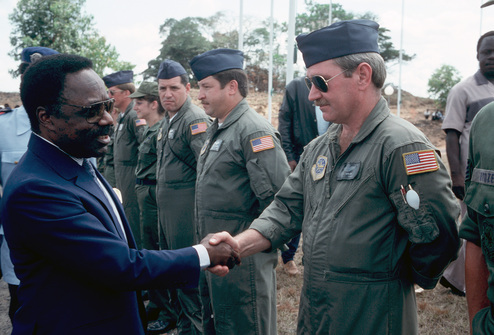
Header photo: President Omar Bongo thanks participants in Gabon Medflag 88, in which American military personnel provide medical assistance and training to citizens of his West African nation. The original finding aid described this photograph as: Country: Gabon (GAB) Scene Camera Operator: SGT Paul A. Tubridy Release Status: Released to Public
Discover More
This remarkable story is only one chapter in the long and often forgotten history of Africa's connections with the wider world. Explore more articles on African kingdoms, Pan-African history, global cultural exchanges and the extraordinary individuals whose lives linked Africa with Europe, Asia and the Americas. Every story opens another door into Africa.