Nyayo House — The Torture Chambers Under Nairobi, and the 1991 Decree That Still Keeps Them Shut
African Independence · Kenya · Memory and the State
Nyayo House — The Torture Chambers Under Nairobi, and the 1991 Decree That Still Keeps Them Shut
In the basement of a twenty-six storey government tower in central Nairobi are the cells where Kenyans were held and tortured during the rule of Daniel arap Moi. Upstairs, people queue for passports. Downstairs, the doors stay locked — not by the old regime, but by three governments that came after it, under a legal notice the regime itself issued in 1991 and which nobody has repealed. The survivors have been asking to get in since 2003.
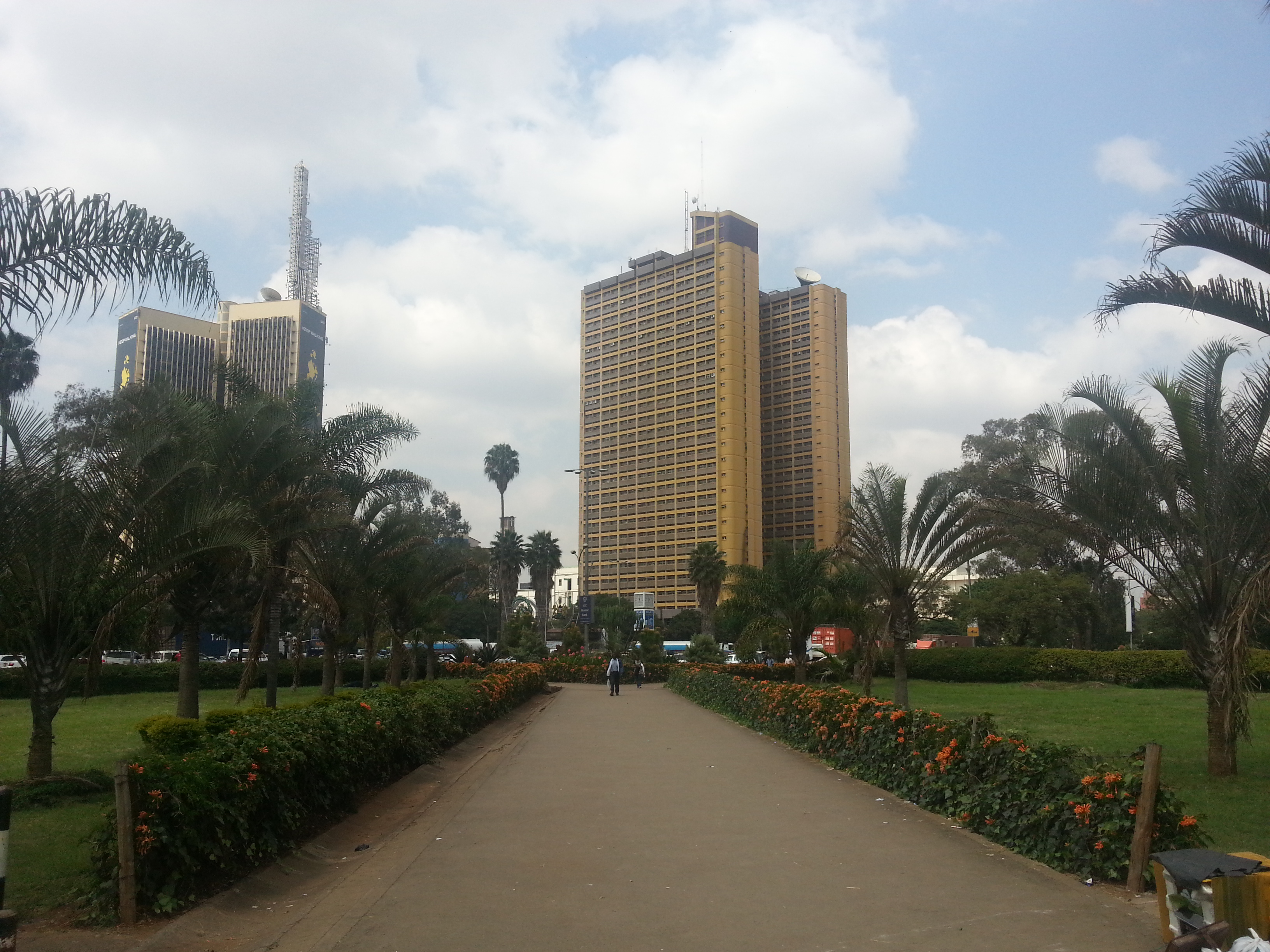
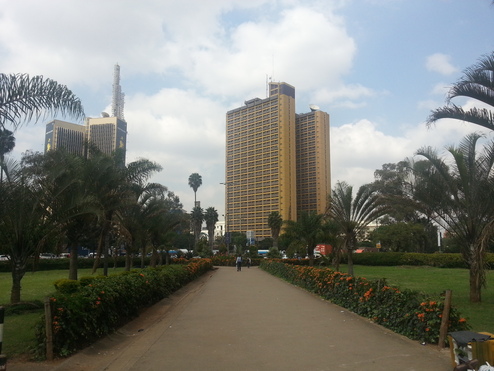
Nyayo House, Nairobi. Photo: raidarmax, own work, licensed under CC BY-SA 3.0, via Wikimedia Commons.
The building does not look like anything. That is the first thing to understand about it. Nyayo House is a plain government tower of the early 1980s on the corner of Kenyatta Avenue and Uhuru Highway, in the middle of Nairobi, with the kind of façade that makes your eye slide off it. Thousands of Kenyans walk through its doors every week on entirely ordinary business — immigration, passports, paperwork. They stand in a queue on the ground floor of a building whose basement was purpose-built for torture.
That is not a figure of speech. Kenya's own Truth, Justice and Reconciliation Commission examined the site and concluded that the chambers beneath Nyayo House were built deliberately as infrastructure for political violence and control — architecture designed for the purpose it served.
What was built, and when
Daniel arap Moi took office in 1978 and ruled for twenty-four years, in a style defined by centralised power, restricted political freedom and violence used as a tool of government. In August 1982 a section of the air force attempted a coup against him. It failed. What followed was a decade of hunting down anyone suspected of disloyalty: students, lecturers, lawyers, writers, trade unionists, members of the underground Mwakenya movement, and a great many people who were simply in the wrong conversation.
Nyayo House was completed in 1983, the year after the coup attempt, and became central to maintaining that state of fear.
The layout is worth stating plainly, because the ordinariness of it is the horror. The interrogation rooms were on the twenty-fourth, twenty-fifth and twenty-sixth floors — at the top of the building, above the offices, with a view over the city. The cells were in the basement: described in the survivors' own accounts as dark, cramped and frequently flooded. People were brought up in the middle of the night to be questioned, subjected to physical and psychological torture to force confessions, and taken back down again. Some were later charged and sentenced. Some were released without ever being charged with anything. Some did not come out.
Those numbers come from the record compiled by the survivors themselves. Nobody claims they are complete. They are what could be counted.
The decree that outlived the regime
Here is the detail that turns this from a history piece into a live story, and it is the reason this article exists.
On 1 February 1991, the Minister of State Jackson Angaine issued Legal Notice Number 11, under the Protected Areas (Amendment) Order, declaring Nyayo House a protected area. The purpose at the time was straightforward: to shield the illegal detentions and torture happening inside from any outside scrutiny.
That legal notice has never been repealed.
Access to the former chambers today requires the permission of the Nairobi County Commissioner and of the National Intelligence Service. A researcher who worked at the site recently reported that even obtaining approval to bring a group of twenty participants into the basement ran into repeated obstruction from the intelligence service.
A decree written by the regime to hide its crimes is still the instrument that keeps the victims out of the room where those crimes were committed.
One open day in forty years
The chambers were opened to the public exactly once, on 18 February 2003, shortly after Moi left power. Survivors walked back into the basement. The incoming government promised them that the place would become a monument of shame and a museum of the struggle for human rights — so that Kenya could say, and mean, never again.
There has been no unrestricted access since.
Kenya's Truth, Justice and Reconciliation Commission investigates historical injustices. Nyayo House features heavily in survivor testimony. Unusually, the hearings on torture there are held in the basement itself, among the broken walls and the empty cells.
The then Prime Minister Raila Odinga tours the facility and declares that it should become a memorial.
The TJRC's final report recommends that the former chambers be turned into a public memorial and museum, as symbolic reparation to survivors and as a guarantee against repetition. The recommendation carries a one-year implementation deadline.
The deadline passes. Successive governments do not implement it.
The Kenya Human Rights Commission, the Law Society of Kenya and four survivors — Wachira Waheire, Florence Murage, Joseph Manje and Ngotho Kariuki — petition the courts for national monument status, on behalf of all former detainees. The petition records that there have been attempts to destroy the chambers and cover up what happened in them.
The case is still live. The basement is still closed. The 1991 legal notice is still in force.
Why this is not a story about one bad man
It would be easy to write this as a piece about a dictator, and the material is there. Moi died in February 2020 without ever answering the accusations against him, and he refused to engage with his own country's truth commission while it sat. The men who ran the security apparatus of that period are largely dead too. Where individuals are named in connection with Nyayo House, that naming belongs to the TJRC's findings and to the courts, not to a website — and this one will not go further than those records go.
But the villain framing lets the reader off. If the story is about a man, and the man is dead, then the story is over.
It is not over. What keeps the basement of Nyayo House closed in 2026 is not Moi. It is an unrepealed statutory instrument, an intelligence service that controls the keys, and a recommendation from Kenya's own commission that three administrations have declined to act on. A state that has held hearings in a torture chamber, published a report about it, and then locked the door again is making a choice — and it is a choice being made now, by people who are alive and in office.
The continuity is the point. Researchers working with the survivors describe a line running from the Mau Mau struggle through the Mwakenya arrests of the 1980s to the Gen Z protests of recent years and the police violence that met them. Young Kenyans who were not born when Nyayo House was built have joined survivors on their memorial visits to the basement. On the wall of the Mathare Social Justice Centre is painted Milan Kundera's line about the struggle of memory against forgetting.
A state that refuses to memorialise its past violence is not only failing the people it hurt forty years ago. It is telling the people it is hurting now what they can expect.
What a memorial would actually do
Kenya already knows how this works, and so does the rest of the continent. On the coast of Ghana, the dungeons of Cape Coast Castle and Elmina Castle are open. People walk down into them. It is unbearable, and it is the reason they matter: a place where something was done to human beings, preserved as evidence, with the door unlocked.
That is what the TJRC recommended for Nyayo House. Not a plaque. A room you can enter.
The argument against is never made out loud, which is itself telling. Nobody in Nairobi stands up and says the chambers should stay shut. The mechanism is quieter: the notice is not repealed, the permission is not granted, the file moves to another desk, and thirteen years pass. It is the same machinery that lets a government website die unnoticed — an absence of anyone whose job it is — except that here the thing going unattended is not a domain name. It is the only physical evidence of what a state did to its own citizens.
The survivors are in their seventies and eighties now. The state is waiting out a problem that will solve itself when the last of them dies.
One concrete thing would change this tomorrow. Repeal Legal Notice Number 11 of 1991. It was issued to conceal a crime. It survives only because nobody has bothered to strike it out. Everything else — funding, curation, design — is a second-order problem that cannot even be discussed while the building remains legally sealed.
More in this series
- Nyayo House — the full record, the timeline and the campaign for a memorial
- Launch and Abandon — what happens to African state heritage sites after the ribbon is cut
- A Museum Made of Light — Gabon and the first virtual museum in the world
- Cape Coast Castle — the dungeons, and what it means to keep them open
- Elmina Castle — the oldest European structure in West Africa
- Kenya Web News — heritage, parks and reporting from Kenya
- The independence timeline — every African country, every date
Verified: 22 September 2026.
Sources: the final report of Kenya's Truth, Justice and Reconciliation Commission (2013) and reporting on its findings; the Kenya Human Rights Commission's documentation of the Nyayo House torture chambers case, filed with the Law Society of Kenya and four survivors in 2024; Kenyan press reporting from 2021 to 2026, including the survivors' compiled figures; and peer-reviewed research published in 2025 and 2026 on the architecture of the site and on access restrictions. Victim numbers are those documented by survivors and are not presented as complete totals. This page names individuals only where they are named in the findings of the truth commission, in court filings, or as public petitioners, and makes no allegation against any living person beyond what those records contain. Corrections and survivor testimony are welcome and will be published in full.
"The one who tells the truth is never loved at first."
Common in: Various African oral traditions.
Meaning: Speaking truth often brings discomfort, criticism, or isolation before it earns respect. Truth is valuable not because it is pleasant, but because it is necessary.
Discover More
This remarkable story is only one chapter in the long and often forgotten history of Africa's connections with the wider world. Explore more articles on African kingdoms, Pan-African history, global cultural exchanges and the extraordinary individuals whose lives linked Africa with Europe, Asia and the Americas. Every story opens another door into Africa.