Njinga of Ndongo and Matamba: The Queen, the Myths, and the Slave Trade Nobody Mentions
Remarkable Africans · The ones buried under their own legend
Njinga of Ndongo and Matamba: The Queen, the Myths, and the Slave Trade Nobody Mentions
She ruled for thirty-nine years, fought Portugal for most of them, allied with the Dutch, corresponded with the Pope, and built a state that outlived her by two and a half centuries. She also lost repeatedly, was driven out of her own kingdom, and sold captured people to Europeans for guns. Two industries have spent four hundred years lying about her — first the missionaries who called her a cannibal, and now the video channels that have invented a queen who never lost. Here is what the record actually says.
There is a woman circulating online who never lost a battle, who kept a harem of men and had each one killed at dawn, who fought her whole life to end the slave trade, and who single-handedly held off an empire.
She did not exist.
There is also a woman in seventeenth-century European books who ate human flesh, murdered her own family, practised unspeakable cruelties, and was redeemed only by the patient work of Italian missionaries.
She did not exist either.
The real person — Njinga Mbande, born around 1583, dead in December 1663 — spent forty years doing something considerably more difficult than either version allows. She survived. In a corner of Africa being systematically dismantled to supply the sugar plantations of Brazil, she kept a state alive, and she did it by making choices that neither the missionaries nor the video channels want to sit with.
This article is about those choices.
First problem: almost everything we know was written by her enemies
Before any story about Njinga, you have to know where the story comes from.
Ndongo had no written tradition of its own in her lifetime. Almost the entire surviving record was produced by Europeans who were, in one way or another, at war with her.
Then it got worse. In 1732 a French Jesuit rewrote Cavazzi. In 1769 a French novelist turned her into fiction. Scholars who have laid those texts side by side can watch the same anecdote grow new details at each stage, always in the direction of savagery and sex, always in support of the argument that such a people required conquering and converting.
The sensational Njinga was not a misunderstanding. She was a product, manufactured over a century by writers who needed Africa to look like that.
And the modern heroic Njinga is being manufactured the same way, from the same raw material, by people who need her to look like something else.
The country she was born into
Ndongo was a substantial Mbundu kingdom in what is now northern Angola. Its ruler carried the title ngola — and it is from that word, a title mistaken by the Portuguese for a place name, that Angola is called Angola.
The Portuguese arrived on that coast in the 1480s and founded Luanda in 1575. What followed was not exploration. It was a slaving economy with a military attached.
Brazilian sugar required labour. Luanda supplied it. The demand was effectively unlimited, and it was met by war — Portuguese campaigns inland, alliances with African warlords, raids, and the steady conversion of Ndongo's population into cargo.
By the early 1600s Ndongo was being taken apart. Its provincial lords, the sobas, were being detached one by one. Its people were being carried off in numbers that broke the kingdom's ability to function.
This is the situation Njinga inherited. Not a proud independent kingdom threatened by newcomers — a state already half-consumed.
The family
She was born around 1583 at Kabasa, the Ndongo capital, daughter of the ngola Kiluanji. Her name is said to come from the umbilical cord found wrapped around her neck at birth, read as a sign.
She was trained in court ceremony, in Kimbundu rhetoric, in weapons and in diplomacy, and as a girl she went with her father to councils and watched embassies to Luanda.
Her brother Ngola Mbandi took the throne in 1618, and here the sources describe something ugly: that he had Njinga's young son killed to remove a rival claim, and that Njinga herself was rendered unable to bear more children.
Those accounts come to us through the same hostile European filter and cannot be independently verified. They are consistent enough across the sources to be taken seriously, and uncertain enough that no honest article states them flatly.
What is clear is that the relationship between brother and sister was poisonous, and that by 1621 Mbandi was losing his war so badly that he had to send for her anyway.
1622: the chair
This is the most famous story about Njinga, and it is the one people assume is invented. It is in the sources.
Mbandi sent her to Luanda to negotiate with the Portuguese governor. She arrived as ambassador of a losing kingdom, with almost nothing to bargain with.
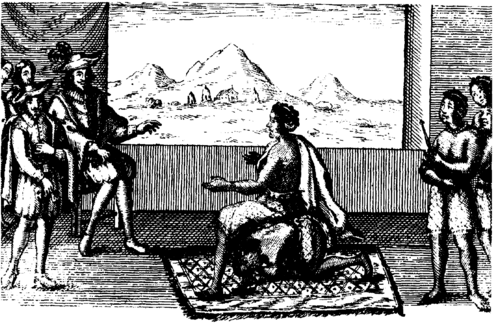
The governor received her in a room where he sat in a chair and a mat had been laid on the floor for her. It was not an oversight. It was the whole negotiation, conducted before a word was spoken.
Njinga signalled to one of her attendants, who went down on hands and knees. She sat on the servant's back, at the governor's eye level, and opened the discussion.
She got what she came for: the Portuguese agreed to terms that treated Ndongo as a sovereign kingdom rather than a vassal, and she was not required to accept tribute status. She also agreed to be baptised, taking the name Ana de Sousa after her godparents.
The chair is usually told as defiance. It was more precisely a piece of diplomatic technique. She understood that the room was an argument about status, and she rewrote the room.
It is worth noticing what the story requires: that a woman in her late thirties, from a kingdom being destroyed, walked into the capital of the people destroying it and won the encounter. That is not a myth. It is in the record. And it tells you more about her than any invented battle.
Even here, though, the later European rewrites cannot leave it alone — the anecdote acquires embellishments in each retelling through the eighteenth century. The kernel is sound. The decoration is not.
1624: power, and the accusation
Mbandi died in 1624. Njinga took over — initially as regent for his son, then as ruler in her own right.
She was accused, then and since, of having poisoned him. She was accused of having his son killed too.
The accusations come from parties with obvious interests: Portuguese officials who wanted her delegitimised, and rival Ndongo lineages who did not want a woman on the throne. There is no proof. There is also no way to clear her. Historians generally record the charge and decline to settle it, and so do we.
Her legitimacy problem was severe and it was permanent. Ndongo's succession was elective among the royal lineage, and a female ruler was outside precedent. Powerful sobas refused her.
Her response was to govern as a king rather than as a queen. She required male forms of address. She led armies in the field personally, into her seventies. She adopted, deliberately and visibly, the attributes of male authority — because the alternative was not being obeyed.
Driven out
Then she started losing. This is the part the heroic version deletes entirely.
Portuguese forces drive her from Kabasa and install a rival, Ngola Hari, as their client ngola of Ndongo. She becomes a ruler without a capital.
Portuguese troops catch and destroy her camp. Her two sisters, Kambu and Funji, are captured and taken to Luanda, where they are paraded naked before the governor. Njinga escapes.
She allies with the Imbangala — mobile warrior bands with their own brutal military culture, previously used by the Portuguese against her — and adopts some of their rites to hold the alliance together.
She takes the neighbouring kingdom of Matamba by force from its own ruler, and moves her court there. Matamba is defensible, resource-rich, and sits astride the inland routes.
Read that sequence again. She was beaten out of her country, lost her sisters to the enemy, allied with the warriors who had been hunting her, and then took someone else's kingdom to have somewhere to stand.
She did not win her way to Matamba. She was driven there, and she conquered it because she had nowhere else.
The undefeated queen of the internet would have been dead by 1630. The real one survived because she lost, adapted, and started again somewhere else — three times.
The Dutch years, and the guns
From Matamba she did the thing that made her genuinely dangerous. She closed the roads.
In the 1630s she blocked the main inland slaving routes toward the Kwango, cutting Portuguese buyers off from the interior supply. Portuguese officials in Luanda complained to Lisbon that she was strangling their trade. Militarily she was hard to catch; economically she was worse.
By 1635 she headed a coalition that included Matamba, Ndongo elements, Kongo, Kasanje and others.
Then Europe handed her an opening. Portugal and the Netherlands were at war, and in 1641 a Dutch fleet took Luanda.
Njinga allies with the Dutch West India Company. She supplies captives taken in war; the Dutch supply firearms and military support.
She defeats a Portuguese army that attacks her in Matamba.
She is defeated by the Portuguese. The Dutch agree to reinforce her.
At Kombi, the combined Dutch and Matamban force destroys a Portuguese army. Portuguese survivors are besieged in their inland forts. For a moment it looks as though Portugal will be pushed off the coast entirely.
A fleet arrives from Brazil under Salvador de Sá and retakes Luanda. The Dutch make terms and leave. Njinga's most powerful ally sails away and she is back where she was.
Now read the 1641 line again, slowly.
The part nobody mentions
Njinga traded in enslaved people.
Not as a rumour. Not as a colonial slander. As policy, over decades, documented on both sides.
She exchanged war captives with the Dutch West India Company for firearms and support. Her wars produced prisoners, and prisoners were the currency that bought the guns to fight the next war. Under her and after her, Matamba became one of the major suppliers of captives on that coast, sitting on the routes and taxing or supplying what moved along them.
When she closed the slave roads in the 1630s, she was not abolishing anything. She was denying a resource to an enemy — the same act as blockading a port. When it suited her to sell, she sold.
And the other half of it is equally true, which is why this is worth writing carefully.
Njinga's territory took in people who ran from Portuguese-held areas — escaped captives, deserting soldiers, whole displaced communities. Portuguese officials complained repeatedly that her camps were draining the labour they depended on. She kept many captured people as soldiers rather than selling them, which built her army and cost Luanda its cargo.
She was, simultaneously, a refuge from the Atlantic trade and a participant in it. Both are documented. Neither cancels the other.
Here is why this matters beyond her.
The seventeenth-century Atlantic system did not run on European raiding parties marching inland. It ran on partnership. European buyers on the coast, African states supplying from the interior, war as the mechanism of supply. Ndongo, Matamba, Kasanje, Kongo and the Imbangala were all inside that system, at different times and on different terms, and so were the Portuguese, the Dutch, the Brazilians and eventually everyone else who wanted sugar.
Njinga was not an exception to her world. She was one of the more skilful operators in it.
You cannot understand how eleven million people crossed that ocean without understanding that African states supplied a great many of them, and you cannot understand why without understanding that guns bought captives and captives bought guns.
Saying so is not a defence of Portugal. Portugal built the demand, ran the ships, worked the plantations and took the profit, and the scale of what Europe did has no African equivalent. But an account of the trade with only Europeans in it is not an anti-colonial account. It is a simpler kind of condescension — Africans as scenery in their own history, incapable of agency even when the record shows them exercising it.
Now the myths, one at a time
"She never lost a battle"
False, and not by a small margin. She lost her capital in 1626. Her camp was destroyed and her sisters captured in 1629. She was beaten badly in 1646. She was driven out of Ndongo and spent most of her reign ruling from a kingdom she had taken because her own was occupied. She never recovered Ndongo by force — she got recognition at the negotiating table in the 1650s, thirty years later.
"She kept a harem and had each man killed after one night"
This is the big one, and it is a chain of embellishment.
What the seventeenth-century sources actually describe is that during the 1640s she took multiple male companions — usually read by historians as a deliberate adoption of the prerogatives of a male ruler, part of the same strategy as being addressed as king. Cavazzi adds a strange claim of his own: that she made these men sleep alongside her serving women without touching them.
The version where they fight each other for the privilege and are executed at sunrise appears in later European rewriting and in eighteenth-century French fiction, not in the accounts of men who were there. It is now recycled endlessly online as fact.
And after her return to Catholicism in the 1650s she gave the arrangement up and married one man. That part never makes it into the video.
"She was a cannibal"
This comes from her alliance with the Imbangala, whose ritual practices horrified and fascinated the missionaries, and from Capuchin writers whose entire narrative arc required her to have been as depraved as possible before her conversion so that the conversion would mean something.
The claim served a purpose, the purpose is visible in the text, and no serious historian treats it as established.
"She fought her whole life to end the slave trade"
Addressed above. She fought to control it, to deny it to her enemies, and to profit from it when that served her. Ending it was never the object and would not have been an intelligible goal in her world.
"The chair story is a colonial invention"
Ironically, no. That one is in the sources.
The last years
What she could not win by fighting, she got by outlasting.
She wrote to Rome. She corresponded with the Pope. She admitted Capuchin missionaries and used them as diplomatic channels. She made Christianity a state project in Matamba — and historians have argued for decades over how much of that was belief and how much was statecraft, with the honest answer probably being that she saw no reason to separate them.
She negotiated for years for the return of her surviving sister, held in Portuguese hands.
Peace with Portugal. Njinga is recognised as legitimate ruler of Matamba. Boundaries are fixed. She agrees to admit missionaries, to end Imbangala practices among her people, and to let her followers settle in villages and raise children rather than live as mobile war camps.
Eyewitnesses describe her leading military parades in her late seventies, still an imposing figure.
She dies, aged about eighty, after thirty-nine years in power.
Her sister Kambu — baptised Barbara — succeeded her and ruled until 1666. After a civil war the throne eventually passed to a general, but Matamba went on being ruled by women for much of the following period, which was unusual anywhere in the world at that date.
What she actually achieved
Forget the undefeated warrior. Here is the real measure, and it is bigger.
The Portuguese occupied the Ndongo lands in 1671, eight years after her death.
Matamba stayed independent into the early twentieth century.
The state she assembled out of defeat, exile and conquest — with borrowed military culture, Dutch guns, Catholic diplomacy and captives sold to pay for it — survived European conquest for roughly two hundred and fifty years after the woman who built it was dead.
Almost nothing else in that part of Africa did.
She did not defeat the Atlantic system. Nobody did. She kept a door open in it for a quarter of a millennium, and that is a larger thing than any battle she is falsely credited with winning.
The sanitising is not only European
One more thing, because it goes to the heart of why this article exists.
When Angola made its feature film about Njinga, and when the Angolan government worked with UNESCO on a commemorative comic book for the 350th anniversary of her death in 2013, both left things out.
The male companions went. The periods of genuine negotiation and accommodation with the Portuguese went, in favour of a cleaner story of unbroken resistance. Scholars examining these projects have pointed out that they were doing precisely what the Capuchins did — selecting which parts of a life were acceptable truths — only with the arrow pointing the other way.
Colonial writers made her a monster to justify conquest. Nationalist writers made her a saint to build a nation. Neither wanted the woman who bought guns with prisoners and won an argument by sitting on a servant.
She is not the only one. She is simply the clearest case, because the sources are rich enough to catch both sides at it.
Why she belongs on this site
Because African independence did not begin in 1957 or 1960. Njinga was defending sovereignty against a European power three hundred years before the word decolonisation existed, and she was doing it with the tools that were actually available to her rather than the ones we would prefer she had used.
And because of what her story does to lazy history.
The heroic version and the demonic version are the same product — a simple African, easy to hold in one hand. What is on the record is a shrewd, ruthless, adaptable head of state who was beaten more often than she won, who allied with anyone who could arm her, who traded in human beings and sheltered them from being traded, who was baptised twice for reasons that were at least partly tactical, and who died in her bed at eighty still in possession of a kingdom.
She was not simple. Nothing in this history is.
That is exactly why it should be told properly, and it is why the click-farms will not tell it. A woman who lost three times and adapted is a harder edit than a woman who never lost at all.
What remains
There is a statue of her in Luanda, put up by the Angolan government for the 350th anniversary of her death in 2013. Couples pose at it. It is a good statue.
There is her name on streets and schools, and there was a version of her carried across the Atlantic in the heads of people who were sold out of that coast, some of them by her. In Brazil, communities descended from Angolan captives still crown a Queen Njinga in their festivals.
There is Cavazzi's manuscript, still the best source we have and still written by a man who needed her to have been a monster first.
And there is a kingdom, Matamba, that a woman built out of losing, which stayed free for two hundred and fifty years after she died and is now a region on a map that almost nobody outside Angola can find.
That is the actual monument. It just doesn't fit in a caption.
Connected reading & sources
- The minerals still leave
- Mobutu Sese Seko — the man who killed African independence
- Academic rebuttal — there is no evidence Anton Wilhelm Amo was taken to Europe as a slave
- Anna Madgigine Jai Kingsley — the Wolof girl who defended her freedom
- Madame Abomah — the Dahomey warrior who was born in South Carolina
- The long road to freedom — the leaders who paid the highest price
- John Thornton's English translation of Cavazzi's 1665 manuscript — the primary source, online and free
- Encyclopaedia Britannica — Nzinga
- Dictionary of African Christian Biography — Njinga
- South African History Online — Njinga Ana de Sousa
- Enslaved.org — Njinga, from the Dictionary of Caribbean and Afro-Latin American Biography
- H-Net review of Linda Heywood, Njinga of Angola: Africa's Warrior Queen
Verified: 7 September 2026.
Checked against Linda M. Heywood's Njinga of Angola: Africa's Warrior Queen (Harvard University Press, 2017) and its scholarly reviews, John K. Thornton's work on Njinga's legitimacy and his English translation of Giovanni Antonio Cavazzi's 1665 manuscript, Joseph C. Miller's reassessment of Njinga in the Journal of African History, the Dictionary of African Christian Biography, Encyclopaedia Britannica, South African History Online and academic work on the literary construction of Njinga's image in European and modern Angolan sources. The dates of her birth around 1583, the Luanda embassy of 1622, her accession in 1624, her expulsion from Kabasa in 1626, the capture of her sisters in 1629, her conquest of Matamba in 1631, the Dutch capture of Luanda in 1641 and its recapture in 1648, the peace settlement of 1656–57 and her death on 17 December 1663 are as recorded. Where the record is contested it is stated as contested: the allegations that she poisoned her brother or killed his son originate with parties hostile to her and are unproven; accounts of her son's death and her subsequent inability to bear children reach us only through European sources; and claims of cannibalism and of male companions being executed after a single night are identified here as products of missionary polemic and later European fiction rather than findings of the historical record. Her participation in the Atlantic trade in captives, including the exchange of prisoners of war for Dutch firearms, is documented on both the African and European sides and is stated as fact. This article makes no claim about the merits of any present-day political or legal debate.
Header photo: Njinga of Ndongo and Matamba, a drawing of that time.
Discover More
This remarkable story is only one chapter in the long and often forgotten history of Africa's connections with the wider world. Explore more articles on African kingdoms, Pan-African history, global cultural exchanges and the extraordinary individuals whose lives linked Africa with Europe, Asia and the Americas. Every story opens another door into Africa.