Murtala Mohammed: The Nigerian General Who Was Murdered in His Own Car
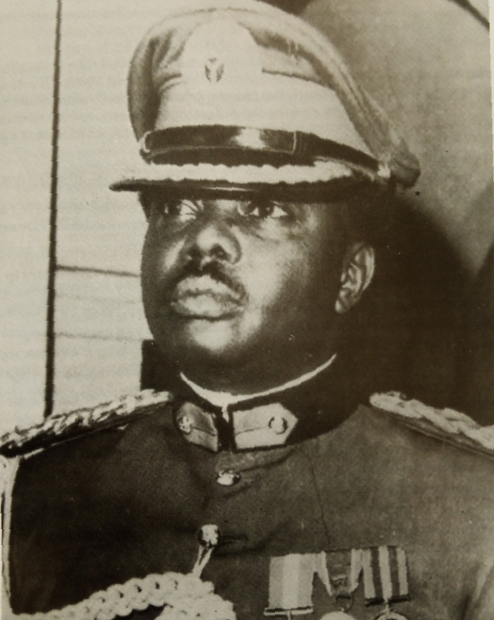
Remarkable Africans · The ones who died in the coup culture
Murtala Mohammed: The Nigerian General Who Was Murdered in His Own Car
He had seized power himself only six months earlier. Thirty-three days before he died he told the OAU that Africa had come of age and no longer took orders from anyone. Then, on a Friday morning in Lagos, soldiers ambushed his Mercedes and shot him dead. The coup failed. His aide was dead. Colonel Ibrahim Taiwo was dead. And Nigeria answered with public firing squads on a Lagos beach in front of thousands of spectators.
There are assassinations that change a country because the victim is a president. There are others that change a country because of what the killing reveals.
The murder of General Murtala Ramat Mohammed belongs to the second category.
He was not a civilian democrat murdered by a military dictatorship. He was a soldier who had helped overthrow Nigeria's previous military ruler. He had taken power through a coup in July 1975.
Six months later, another group of soldiers decided that his government had to go.
They did not merely remove him.
They shot him in his car.
Then they tried to seize the government, the radio station, the military command structure and the country.
They failed.
The people accused of helping them were tried by a military tribunal. Some were imprisoned. Dozens were executed — publicly, on a beach in Lagos, in front of crowds.
And around the entire affair hung the name of the man Mohammed himself had overthrown only months earlier: General Yakubu Gowon.
A note on the spelling
You will see this man's name written as Murtala Mohammed, Murtala Muhammed and Murtala Muhammad, sometimes within the same publication. Nigerian official sources are not consistent either. Lagos airport uses Muhammed. We use Mohammed throughout for readability. It is the same man.
Nigeria before Murtala
Nigeria had been independent since 1960. By the middle of the 1970s, however, the country had become trapped in the machinery of military rule.
The first military coup came in January 1966. A counter-coup followed later that year. Then came civil war.
The Biafran War ended in 1970, but the military remained in power.
General Yakubu Gowon had become head of state in 1966 and remained there until July 1975.
By then, dissatisfaction inside the armed forces had become serious. There were arguments about corruption, promotions and political direction. Above all there was the broken promise: in October 1974 Gowon announced that Nigeria would not be ready for civilian rule in 1976 after all, and postponed the handover indefinitely.
Oil money was pouring in and visibly failing to arrive anywhere useful. Gowon himself is remembered for remarking that Nigeria's problem was not money but how to spend it.
Among the dissatisfied soldiers was Brigadier Murtala Mohammed.
The part of his record that gets left out
Before we reach 1975, there is a section of this man's life that Nigerian commemorations tend to walk past quickly. It cannot be walked past here.
During the Nigerian Civil War, Mohammed commanded the Nigerian Army's 2nd Division.
In August 1967 Biafran forces crossed into the Mid-Western Region, took Benin City and pushed west as far as Ore. Mohammed's division drove them back east towards the Niger. The retreating Biafrans blew the Onitsha end of the River Niger bridge, leaving federal troops stranded on the Asaba bank.
What happened next in Asaba, between 5 and 7 October 1967, is one of the darkest episodes of the war.
The Asaba massacre. Soldiers of the 2nd Division moved through the town killing civilians, looting and burning houses. On 7 October the town's leaders organised a gathering, with people dressed in ceremonial akwa ocha, to demonstrate loyalty to a united Nigeria. Survivors describe men and boys being separated from the women and children at a junction and then shot in the open.
Estimates of the dead generally run between 500 and 800, and some accounts go higher. The 2nd Division was under Mohammed's command. Major Ibrahim Taiwo is named in the scholarly and survivor accounts as directing part of the killing of the men.
Hold that name. Ibrahim Taiwo will die alongside Murtala Mohammed nine years later, on the same February morning, killed by the same conspiracy.
The definitive study is The Asaba Massacre: Trauma, Memory, and the Nigerian Civil War by S. Elizabeth Bird and Fraser Ottanelli, published by Cambridge University Press and launched in Asaba at the fiftieth anniversary commemoration in October 2017.
Mohammed was never charged, never tried and never required to account for it.
His war record after Asaba was not distinguished either. He threw men repeatedly across the Niger at Onitsha and lost them. A first assault was routed. A five-thousand-strong reserve brought up from Lagos was defeated. A third attempt failed. He eventually abandoned the crossing and moved north to Idah.
Then, on 31 March 1968, his division was ambushed at Abagana by a far smaller Biafran force under Major Jonathan Uchendu. The 2nd Division was effectively destroyed. Of roughly six thousand men, only a small number came out. Mohammed was one of them.
The man Nigeria would later put on its banknotes commanded the division responsible for Asaba, and lost most of that division in a single ambush at Abagana.
None of this is a reason to skip him. It is a reason to write about him honestly.
The coup that put Murtala in power
On 29 July 1975, soldiers overthrew Gowon.
The coup was largely bloodless. Gowon was abroad, attending an Organisation of African Unity summit in Kampala. The broadcast announcing his removal was made by Colonel Joe Nanven Garba.
Murtala Mohammed emerged as the new Head of State, with Lieutenant-General Olusegun Obasanjo as his deputy and General Theophilus Danjuma in another central position in the new military leadership.
The Nigerian National Library's historical material describes the July 1975 coup as the event that brought Mohammed to power. The Central Bank of Nigeria records his period as Head of State as July 1975 to February 1976.
There is an important irony here.
Murtala Mohammed did not enter power through an election. He entered through a coup. Six months later, he would be murdered by men attempting to do exactly the same thing to him.
The soldier who moved fast
Mohammed's government was authoritarian. It was military rule. It suspended normal democratic politics.
But it was also unusually energetic, and that is why Nigerians remember it.
He reorganised the federal structure, created new states, and began preparing a political programme leading to a return to civilian rule. The Central Bank of Nigeria records that his government planned new states, a new constitution, and state and national elections leading toward civilian rule in 1979.
He also purged the public service — and this is the second thing the commemorations skip.
In the months after July 1975, on the order of around ten thousand public officials were dismissed. Civil servants, university staff, judges, police, diplomats, parastatal managers.
Many were corrupt. Many were not. The dismissals were frequently summary — "with immediate effect" — with no hearing, no stated charge and no appeal. Careers ended by announcement.
It was enormously popular. It was also the destruction of any expectation that a Nigerian public servant had rights that a government was obliged to respect, and later governments used the precedent freely.
He made one more decision whose consequences are visible every time someone looks at a map of Nigeria.
Abuja
Lagos was overcrowded, congested and geographically off-centre. Mohammed's government decided that Nigeria needed a new federal capital.
A panel headed by Justice Akinola Aguda examined the question.
The government accepted the recommendation for a new Federal Capital Territory in the centre of the country, and on 3 February 1976 Mohammed issued the proclamation establishing the move.
Abuja was born under his government.
He would not live to see the new capital completed.
The irony is almost brutal: one of the most consequential decisions in modern Nigerian history was made by a military ruler who would be dead ten days later.
"Africa has come of age"
This is the section that matters most on this website, and it is usually reduced to a single quotable line.
In late 1975 Angola became independent from Portugal and immediately fractured. The MPLA held Luanda. The FNLA and UNITA fought it — and apartheid South Africa entered the war on their side, with American backing.
The OAU called an extraordinary summit in Addis Ababa to decide which Angolan government Africa would recognise. The continent was split roughly down the middle.
Before the summit, the American ambassador in Lagos delivered a letter from President Gerald Ford, pressing Nigeria not to recognise the MPLA on the grounds of its Soviet support.
Mohammed's answer, on 11 January 1976, was to read the letter's substance out and demolish it in public.
The speech argued that Angola was merely the pretext for a new partition of Africa into spheres of influence; that Africa was no longer in the orbit of any power outside the continent and should take orders from none, however strong; that Africans had been treated for too long as adolescents who needed foreign experts to identify their own friends and enemies; and that a United States which had chosen white minority rule over African self-determination had disqualified itself from telling Africa who its friends were. He asked the assembly to recognise the MPLA as the government of Angola and to seat Agostinho Neto.
Nigeria then put its diplomatic weight behind that position across the continent.
The OAU recognised the MPLA.
For a few weeks in early 1976, the most powerful independent voice in Africa was a Nigerian general telling Washington, in public, that the continent was no longer taking instructions.
He was dead thirty-three days later.
And here the responsible account has to stop. The proximity of those two facts has fuelled fifty years of Nigerian speculation about American involvement in his assassination.
The speculation is understandable. It is not evidence. No declassified record establishes American authorship of the Dimka coup, and this article will not manufacture a conclusion the documents do not support.
What can be said is narrower and still worth saying: he made powerful external enemies over Angola, and he was murdered five weeks later, and Nigerians have never stopped noticing the sequence.
The men who wanted him gone
The principal figure in the coming coup was Lieutenant-Colonel Bukar Suka Dimka, born around 1940, commissioned in 1963, an officer of the Army Physical Training Corps. He was not a newcomer to this: he had taken part in the counter-coup of July 1966.
But Dimka was not acting in a vacuum.
The conspiracy reached high. The most senior name was Major-General Iliya D. Bisalla, the Federal Commissioner for Defence — a respected wartime divisional commander, and the last man most Nigerians would have expected.
Another was Joseph Dechi Gomwalk, a civilian by then, formerly military governor of Benue-Plateau State, and connected to Dimka by marriage.
There were also officers such as Isa Bukar, Ayuba Tense, K. K. Gagara, William Seri, I. B. Rabo and M. Parvwang, whose names would later appear in the tribunal and execution records.
The plotters called themselves the Young Revolutionaries.
Their grievances were serious enough to attract officers, but their support was nowhere near sufficient to control Nigeria.
13 February 1976
The coup plot is already in motion. Key military and political figures are targeted in Lagos and elsewhere.
Mohammed's Mercedes is ambushed in Ikoyi. He and his aide-de-camp are shot dead in the vehicle.
Radio Nigeria carries an extraordinary announcement. Lieutenant-Colonel Bukar Suka Dimka declares that Murtala Mohammed's government has been overthrown by the “young revolutionaries”.
Military units outside Lagos refuse to support the coup. Counter-broadcasts begin, including from Kaduna. The attempted seizure of power starts collapsing.
Mohammed is dead. Lieutenant Akintunde Akinsehinwa is dead. Colonel Ibrahim Taiwo is dead. The coup itself has failed.
The ambush
Mohammed was travelling to work — to Dodan Barracks, the seat of the military government.
His Mercedes was moving through Ikoyi without the kind of heavy escort that might have made an ambush difficult. He was known for dispensing with security theatre, and for sitting in ordinary Lagos traffic.
Soldiers attacked the car.
Mohammed was shot dead.
His aide-de-camp, Lieutenant Akintunde Akinsehinwa, was also killed.
Accounts vary over the precise composition of the hit team; the officers most often named alongside Dimka are Captain Parvwang, Major Rabo and Lieutenant Seri. But the central fact is not disputed: the Head of State was assassinated in his vehicle at the opening of the coup attempt. The U.S. State Department's contemporary record confirms that Mohammed was killed on 13 February and replaced the following day by Olusegun Obasanjo.
This was not a failed assassination.
The assassins achieved the most important part of their immediate objective.
They killed the Head of State.
What they could not do was turn that killing into control of Nigeria.
Ibrahim Taiwo
Another man was killed that morning whose story deserves to be remembered — and remembered in full.
Colonel Ibrahim Taiwo, Military Governor of Kwara State, was abducted and killed by a team reported to have been led by Major K. K. Gagara.
Taiwo was not an accidental casualty. He had been closely associated with the July 1975 coup that brought Mohammed to power, and was therefore a significant figure in the military hierarchy the plotters wanted to destroy.
He is also, as noted above, named in the Asaba accounts as one of the officers who directed the killing of the men and boys in October 1967.
Kwara State University at Ilorin was named for him for years.
Colonel David Jemibewon, Military Governor of Oyo State, was also targeted but survived.
The plot was therefore much larger than an attack on one Mercedes.
The radio station
Control of the radio station mattered enormously.
In a coup, the man who controls the radio can claim that the government has fallen before the country has had time to discover whether it has.
Dimka got into the studios — reportedly led there by a civilian broadcaster, Abdulkarim Zakari, who was also said to have signed martial music records out of the library the night before — and announced the overthrow of Mohammed's government.
His broadcast gave his reasons: corruption, indecision, arrest and detention without trial, weakness on Mohammed's part, and maladministration generally.
Read that list again. It is very close to the list of grievances Mohammed's own faction had used against Gowon seven months earlier.
The announcement stripped the military governors of authority, suspended the chain of command and imposed restrictions on movement.
It sounded like a revolution.
It wasn't.
The commanders of the major formations refused to accept it. Counter-broadcasts came from elsewhere in the country. The coup began dying almost immediately.
Why Dimka lost
The fundamental problem was simple.
He did not have the Nigerian Army.
He had a faction of it.
Once commanders outside Lagos rejected the coup, Dimka's position became impossible.
Government forces moved against the rebels. The broadcasting operation was disrupted. The coup leaders scattered.
Dimka escaped.
For three weeks he was the most wanted man in Nigeria, his face on the front of the Daily Times.
Dimka is arrested near Abakaliki in south-eastern Nigeria, stopped at a checkpoint. By most accounts he identified himself rather than attempting to bluff his way through.
The Gowon question
This is where the historical record becomes particularly interesting — and where a responsible account has to resist turning suspicion into fact.
General Yakubu Gowon was living in Britain, studying at the University of Warwick, after being overthrown in July 1975.
In his interrogation and before his execution, Dimka stated that he had met Gowon in London, that Gowon had supported the plan, and that the purpose of the coup was to restore Gowon as Head of State.
The tribunal accepted enough of this to act. On 24 March 1976 Nigeria formally requested Gowon's extradition from Britain.
Britain refused.
Gowon was tried in absentia, declared wanted, dismissed from the armed forces, stripped of his rank and cut off from his pension — without ever appearing before the tribunal.
He denied the charge then, and has denied it since.
The case never got stronger. In 1981 Lieutenant-General Alani Akinrinade, himself a former member of the Supreme Military Council, said publicly in a Punch interview that there had not been a strong case against Gowon.
President Shehu Shagari pardoned Gowon in 1981, alongside the former Biafran leader Emeka Ojukwu. Gowon returned to Nigeria in 1983. His rank was restored by Ibrahim Babangida in 1987. He is today an elder statesman, and Nigeria has quietly stopped repeating the accusation.
Gowon was accused of involvement. That does not establish that he ordered the coup or the assassination.
The honest version is more interesting than the easy one: the Dimka coup was politically associated with the restoration of Gowon, Dimka named him, Nigeria demanded him from Britain and punished him in his absence — and no court ever tested the evidence, because the only man who could have been cross-examined about it was shot in May 1976.
The tribunal
The government established a military tribunal headed by Major-General E. O. Abisoye.
A large number of officers and civilians were arrested. Death sentences were handed down against a substantial group. The Supreme Military Council confirmed them.
The Obasanjo government then promulgated retrospective decrees — including making concealment of treason an offence punishable by life imprisonment, and creating special military tribunal powers to justify mass execution for coup participation.
Laws written after the act, to punish the act.
And then Nigeria began executing them, in public.
Bar Beach
This is the part that international accounts of 1976 tend to render as a statistic.
Lagos had an execution ground: the open sand at Bar Beach on Victoria Island, where stakes were driven in and condemned men were tied to them and shot in front of crowds. It had been used for armed robbers since 1971, and it was a public event — thousands of spectators, press photographers, television cameras.
The first batch of convicted plotters is executed. Brigadier Shehu Musa Yar'Adua, the new Chief of Staff, announces that Major-General Iliya Bisalla and twenty-nine others have been shot. The New York Times carries it on 13 March. The beach is packed with onlookers.
Dimka and a second group are executed, among them Joseph Gomwalk and Colonel Isa Bukar. Accounts differ over whether this batch died at Kirikiri Maximum Security Prison or at Bar Beach, and over whether there were seven or eight of them.
Yar'Adua also stated publicly that the plotters' motive had been Mohammed's plan to cut the size of the armed forces.
The names associated with those condemned included:
Published lists are not perfectly consistent in spelling, rank or counting. Totals of those executed across both batches are variously given as thirty-two, thirty-seven and thirty-nine, depending on whether unnamed non-commissioned officers are included. We have retained the names that can be traced in the historical lists rather than silently correcting them into a false certainty.
Dimka had failed to overthrow the government.
He had succeeded in killing the man who ran it.
For that, he was tied to a stake and shot.
But the story does not end with Dimka
It would be easy to tell this as a simple story about a reckless officer, a failed coup and a deserved punishment.
History is rarely that tidy.
Major-General Iliya D. Bisalla had been Defence Commissioner and a distinguished wartime divisional commander known for post-war reconciliation work. He was executed.
Joseph Gomwalk, a former military governor and by then a civilian, was executed.
Gowon's relatives in the armed forces were hounded out or jailed.
Dozens of soldiers were executed, imprisoned, dismissed or forced into retirement.
The punishment was therefore not simply the elimination of Dimka. It was a purge of part of the military establishment, carried out under laws written afterwards, and finished on a beach in front of a crowd.
A government that had come to power denouncing detention without trial answered its first crisis with retrospective decrees and public executions.
And then came Obasanjo
On 14 February 1976, one day after the assassination, Lieutenant-General Olusegun Obasanjo became Head of State.
The United States State Department's contemporary record is explicit: the coup had failed, Mohammed had been killed, and Obasanjo succeeded him the following day.
Obasanjo had been one of the central figures of the government Mohammed left behind, and by his own later account did not particularly want the job.
And he did something extraordinary.
He continued Mohammed's programme.
The state-creation programme continued. The move toward Abuja continued. The preparation for a new constitution continued. The eventual return to civilian government continued.
On 1 October 1979, Nigeria returned to civilian rule, and Obasanjo handed power to an elected president — something almost no African military ruler of that era did voluntarily.
The military had taken power in 1966.
It took thirteen years to give it back. It would take it again in 1983.
The man who changed the map
Mohammed's life had lasted only thirty-seven years.
Yet his fingerprints remain all over modern Nigeria.
He was born in Kano on 8 November 1938. He trained at Sandhurst in Britain and served in the Nigerian Army, including on the Congo peacekeeping mission and throughout the Nigerian Civil War.
He became Head of State in July 1975.
He was murdered seven months later.
He never saw Abuja become Nigeria's capital.
He never saw the 1979 elections.
He never saw the constitution his government helped prepare.
He never saw whether Angola survived the war he had committed Nigeria to.
He had enough time to change the direction of Nigeria, but not enough time to see where that direction led.
The uncomfortable truth about Murtala Mohammed
An honest article cannot turn Mohammed into a democratic hero.
He was a military ruler who ruled without an elected mandate, having helped overthrow a government.
He commanded the division that carried out the Asaba massacre, and was never called to answer for it.
He dismissed thousands of public servants without hearings and normalised summary punishment as governance.
That matters, and Nigerian commemoration has been shamefully quiet about the first of those things in particular.
But it is equally dishonest to pretend that his government accomplished nothing.
The decision to create a new federal capital changed Nigeria permanently. The federal structure was reorganised. A programme for civilian rule was laid out and — unusually — actually delivered by his successor. And at Addis Ababa he did something no other Nigerian leader has done before or since: he made Nigeria, for a moment, the decisive voice in an African argument with Washington, and won it.
Mohammed was therefore neither the saint of the commemorations nor simply another military dictator.
He was a soldier with blood on his hands from a civil war, operating inside a political system that had become addicted to coups, who used six months of absolute power to do several things his country still lives inside.
The coup culture
This is perhaps the real story.
Nigeria had reached the point where changing the government no longer required an election.
It required enough soldiers, enough weapons, enough radio access and enough commanders willing to recognise you.
Mohammed understood that system because he had used it himself.
Dimka understood it too. He had used it in 1966.
The difference was that Mohammed's July 1975 coup succeeded and Dimka's February 1976 coup did not.
But Dimka's men achieved something that makes the episode unique.
They assassinated the government before they had actually captured it.
The morning that changed Nigeria
Imagine Lagos that morning.
The Head of State is dead in his car in Ikoyi.
The radio is announcing a new government.
Military governors are being told they no longer have authority.
Curfews are announced. Soldiers are moving. Rumours race through the city.
And somewhere inside the military establishment, commanders are deciding the one question that will determine whether Nigeria changes government again:
Whose orders do we obey?
They chose Mohammed's government.
The coup was finished.
But Mohammed was already dead.
What remains
Lagos airport carries his name. His face is on the twenty naira note. There is a road named after him in most Nigerian cities of any size.
None of that tells you very much.
Nigeria has always been generous with monuments and stingy with honest accounting. Asaba waited fifty years for a memorial and a serious book, and got neither from the state.
What actually remains of Murtala Mohammed is a capital city in the middle of the country, a federal map redrawn into more states than he inherited, the timetable that delivered the 1979 handover he never saw, and one speech in Addis Ababa that Nigerians still quote when they want to remember that their country was once loud.
And one more thing remains, less comfortable than a statue.
The demonstration that in the Nigeria of the 1970s, the man at the top could be removed by anyone with a rifle, a Mercedes to ambush and a microphone at Radio Nigeria.
Dimka managed the first two.
He could not hold the third for more than a morning.
Connected reading & sources
- Rawlings — the bloody story of Ghana's 1983 coup attempts
- Thomas Sankara — the African revolution murdered by his best friend
- Mobutu Sese Seko — the man who killed African independence
- Idi Amin — the eight years that broke Uganda
- Omar Bongo — 42 years in power and the French system behind Gabon
- John Magufuli — the president who disappeared
- The minerals still leave
- The long road to freedom — the leaders who paid the highest price
- The Akosombo Dam and Africa's dream of independence
- U.S. Office of the Historian — Nigeria, 1976
- Asaba Memorial Monument — October 1967
- Vanguard — Revisiting the 1967 Asaba massacre
- Full text — "Africa Has Come of Age", Addis Ababa, 11 January 1976
Verified: 6 September 2026.
Checked against the National Library of Nigeria's historical material, Central Bank of Nigeria records of Nigerian heads of state, contemporary United States State Department and diplomatic reporting from 1976, contemporary New York Times reporting of March 1976, the published text of the Addis Ababa speech of 11 January 1976, and academic work on the Nigerian Civil War including The Asaba Massacre: Trauma, Memory, and the Nigerian Civil War (Bird and Ottanelli, Cambridge University Press, 2017). The dates of the July 1975 and February 1976 coups, the Abuja proclamation of 3 February 1976, Dimka's arrest on 6 March 1976, the executions of 11 March and 15 May 1976, and Gowon's extradition request, dismissal, 1981 pardon and 1987 restoration of rank are as recorded. Where published lists disagree — on the spelling and rank of the condemned, on the total number executed, on whether the May batch died at Kirikiri or Bar Beach, and on the death toll at Asaba — the disagreement is stated rather than resolved. Responsibility for the Asaba massacre is described as it stands in the scholarly record: the 2nd Division under Mohammed's command carried it out, and no one was ever charged. Allegations of foreign involvement in the assassination of Murtala Mohammed are identified as speculation, because no declassified record establishes them. This page makes no allegation against any living person.
Discover More
This remarkable story is only one chapter in the long and often forgotten history of Africa's connections with the wider world. Explore more articles on African kingdoms, Pan-African history, global cultural exchanges and the extraordinary individuals whose lives linked Africa with Europe, Asia and the Americas. Every story opens another door into Africa.