Madame Abomah: The Dahomey Warrior Who Was Born in South Carolina
Remarkable Africans · The people history mislaid
Madame Abomah: The Dahomey Warrior Who Was Born in South Carolina
She was advertised across three continents as an eight-foot Amazon from the bodyguard of the King of Dahomey. She was a cook from Laurens County who had never left the United States until she was thirty-one — and who said so, plainly, to any reporter who bothered to ask. Almost none of them printed it.
The last article in this series told the story of a Wolof girl taken from Senegambia and sold in Havana, whose African name was stripped from her and replaced with someone else’s.
This one is the reverse.
Ella Grigsby was born in the American South and had an African identity given to her — manufactured by a British showman, sold to European audiences, and printed on posters from Liverpool to Dunedin. She never set foot in Dahomey. She never held a weapon. She was a domestic cook.
And for thirty years she travelled the world inside that invention, wearing diamonds and ostrich feathers, earning her own money, and correcting the record whenever anybody troubled to ask her a direct question.
Born in the gap
She was born in October 1865, near Cross Hill in Laurens County, South Carolina.
The timing matters more than most accounts allow. Congress had passed the Thirteenth Amendment in January of that year. It was not ratified until December. Ella Grigsby was born in the months between — after slavery had been abolished on paper, before it had been abolished in law.
Her parents had been enslaved. The surname Grigsby was not theirs; it belonged to the family that had owned them, which is how surnames worked for four million people that year.
As a teenager she went to work for a couple named Elihu and Harriet Williams, and took their name instead. Offered a choice between the name of the people who had owned her parents and the name of the people who employed her, she chose the second. It was not much of a choice. It was the only one available, and she took it.
Around the age of fourteen she contracted malaria. She recovered. In the years afterwards she grew, and kept growing, far beyond anyone else in her family. She said so herself, later, without embellishment: none of her sisters or brothers were unusually large.
Years of saying no
She became a cook in Columbia, South Carolina.
And for years — by her own account, years — showmen approached her. Circus promoters, vaudeville managers, men who saw a tall Black woman and immediately saw a ticket price. Every one of them wanted a contract.
She refused all of them.
In 1915 a newspaper finally printed her own words on the subject. She said she was born near Cross Hill in Laurens County, that none of her siblings were unusually large, and that for years every showman who saw her wanted her to sign — but she could never make up her mind to leave Columbia.
That is a woman who was asked repeatedly to sell herself as a curiosity and who said no, for a decade and more, while cooking in someone else’s kitchen for someone else’s wages.
The story is not that she was eventually persuaded. The story is how long she held out.
Bostock, and the invention of Abomah
In the autumn of 1896, at around thirty-one, she signed with Frank C. Bostock.
Bostock was a British showman who dealt in exotic animals and human spectacle, and he understood two things clearly. First, that Ella Williams would draw larger and better-paying crowds in Europe than in America. Second, that European audiences in 1896 were not interested in a cook from Columbia.
So he built her a past.
He named her Abomah, after Abomey — the royal capital of the Kingdom of Dahomey, in what is now the Republic of Benin. And he billed her as one of the Dahomey Amazons: the all-female military regiment of the Dahomean army, an entirely real force still within living memory when she began touring, having been broken by the French only a few years earlier.
The press did the rest. Reports described her as an attendant and bodyguard to the King of Dahomey, trained for war from childhood, hardened to pain, risen to lead his army. Her height was given as eight feet. She could, it was said, support a grown man on one outstretched arm.
None of it was true. She had never been to Dahomey. She had never served any king. She had never fought anyone. Every element of the biography sold to audiences across Britain, Europe, Australia, New Zealand, Cuba and South America was written by her manager in an office, to move tickets.
Even her body was inflated for the poster
The height claims are worth pulling apart, because they show how the machinery worked.
Six feet ten is extraordinary. In the 1890s, for a woman, it was almost unheard of. She did not need exaggerating.
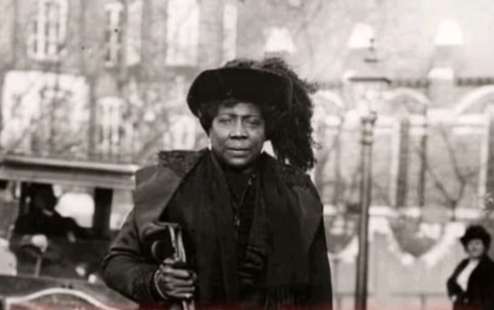
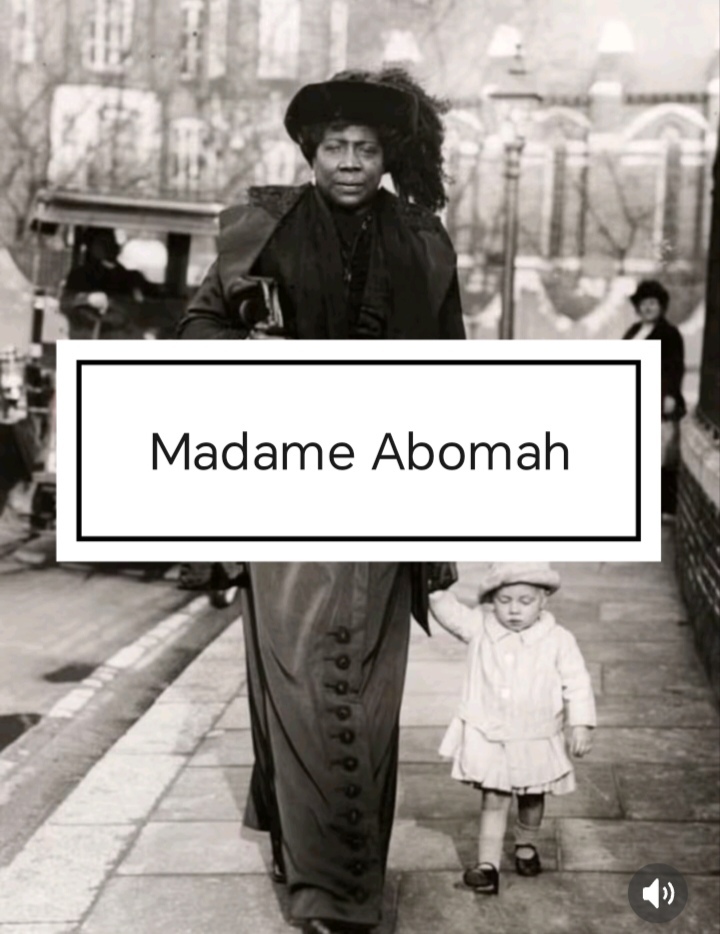
She was exaggerated anyway — and the photographs show how. She was routinely posed beside small white men and beside children, because the contrast did the work the truth would not. The costumes followed the same logic: feathered headpieces and beaded gowns evoking a generic, imagined Africa belonging to no actual people, place or period.
They could not sell a tall woman from South Carolina. So they sold a continent instead, and put her inside it.
What she did with it
Here is where the story turns, and why she belongs in this series rather than in a footnote about Victorian sideshows.
She did not stay a curiosity. She became a headliner.
Over roughly thirty years she toured Britain and continental Europe, Australia and New Zealand, Cuba and South America. She played music halls and variety theatres rather than tents. She appeared on souvenir postcards, which in the Edwardian period was the closest thing to being a celebrity in the modern sense.
And she did not present herself as a warrior. Contemporary accounts and surviving photographs show her dressed expensively and elaborately — jewellery, fine fabrics, careful tailoring. Audiences arrived expecting a savage from the posters and were met by a woman who carried herself like a queen.
That was a choice, and it was hers. She could not control the billing. She could control what people saw when the curtain went up.
There is a further detail that resists every category: alongside the touring, she also worked as a nanny. The woman advertised as a bloodthirsty Amazon spent part of her life looking after other people’s children. Both things were true at once, and only one of them was ever printed.
1914, and getting out
In August 1914 Britain declared war on Germany.
Abomah cancelled her tours and returned to the United States in March 1915. The following month, German airships began bombing London.
She read the situation correctly and left in time. That is not luck; it is judgement, exercised by a woman who had been reading rooms and reading men professionally for nearly twenty years.
Back in America she worked with Ringling Brothers and with Barnum & Bailey, and appeared at Coney Island. She was still performing into the 1920s — by then in her late fifties, which for a physical stage career of that era was remarkable in itself.
She died in 1928, at sixty-three.
Why this story belongs on a pan-African site
A fair question. She was not African. She was an African American woman from South Carolina, and pretending otherwise would repeat exactly the thing Bostock did to her.
She belongs here for a different reason.
Madame Abomah is what Europe wanted Africa to be. Not a real place with kingdoms, laws, trade routes and languages, but a costume — feathers, spears, savagery, an eight-foot warrior queen who could be looked at for the price of a ticket. That fiction was manufactured deliberately, by named individuals, for money, and sold across three continents.
And the person inside it was a working woman who had never been within four thousand miles of the place named on the poster.
The correction she kept making
The detail that stays with me is the 1915 interview.
By then she had been Madame Abomah for nineteen years. The Dahomey story had been printed in a hundred newspapers. She could have let it stand — it was the more marketable version, and nobody was checking.
Asked directly, she said she was born near Cross Hill in Laurens County.
No warrior past. No royal bodyguard. A place name, a county, and the plain fact that her brothers and sisters were of ordinary size.
She wore the fiction on stage and put it down the moment anyone asked her a straight question. That is not a person being deceived. That is a person managing a business, and keeping the truth for herself.
Every forgotten name opens another door
Ella Williams is remembered, when she is remembered at all, as a curiosity in the history of the circus — a tall woman in old photographs, filed under spectacle.
She was a woman born into the last weeks of legal slavery in the American South, who refused offers for over a decade, who accepted on her own timing and on a contract she signed herself, who travelled further than almost any Black American woman of her generation, who dressed like a monarch in rooms full of people expecting a savage, who read a war coming and got herself home, and who worked into her late fifties.
The Dahomey warrior never existed.
The woman from Laurens County did, and she is the better story.
More in this series
- Anna Madgigine Jai Kingsley — the Wolof girl who crossed the Atlantic and defended her freedom
- Franciscus Africanus — the African in Germany before Anton Wilhelm Amo
- The 1931 Colonial Exhibition and the memory of Dahomey
- African radio, live — the whole continent on one page
- The history of Ghana
- Forts and castles of Ghana
- Ghana Museums
Verified: 25 August 2026.
Biographical details compiled from published records and contemporary press accounts of Ella Grigsby Williams (October 1865 – 1928), including her own statements to a South Carolina newspaper in 1915. Birth timing is given against the Thirteenth Amendment’s passage through Congress in January 1865 and its ratification in December 1865. Height figures vary widely between sources: contemporary billing claimed eight feet or more, later accounts commonly cite 7 feet 6 inches, and analysis of surviving photographs suggests approximately 6 feet 10 inches. This page states all three rather than selecting one. The Dahomey Amazons were a genuine all-female regiment of the Dahomean army; no evidence connects Ella Williams to Dahomey, to Abomey, or to any military service, and the biography sold to audiences was constructed by her management for promotional purposes. Descriptions of promotional material and staging are drawn from surviving posters, cabinet cards and press notices of the period.
Madame Abomah: The Dahomey Warrior Who Was Born in South Carolina
Dahomey @ Beninvibes.comDiscover More
This remarkable story is only one chapter in the long and often forgotten history of Africa's connections with the wider world. Explore more articles on African kingdoms, Pan-African history, global cultural exchanges and the extraordinary individuals whose lives linked Africa with Europe, Asia and the Americas. Every story opens another door into Africa.