Kenya, Mau Mau and the Archive Britain Hid for Fifty Years
Remarkable Africans · The ones the archive was hidden from
Kenya, Mau Mau and the Archive Britain Hid for Fifty Years
Britain detained tens of thousands of Kenyans without trial, hanged more than a thousand, drove around a million people into guarded villages, and beat eleven men to death at Hola while telling the world they had drunk bad water. Then it flew the paperwork out of Nairobi at independence and denied for half a century that the paperwork existed. It only came out because five elderly Kenyans took the Foreign Office to the High Court and would not go away.
Most of the articles on this site are about what happened. This one is about what was hidden, for how long, and by whom — because in Kenya's case the concealment is not a footnote to the history. It is the history.
For fifty years, the official British account of the Kenya Emergency was straightforward. There had been a savage, oath-bound terrorist movement. Britain had put it down. It had been unpleasant. Any abuses were the work of a few bad men on the ground, regrettable, isolated, and long since dealt with.
That account survived because the documents that contradicted it were not in Nairobi, and were not at Kew, and officially did not exist anywhere at all.
They were in a country house in Buckinghamshire.
Before anything else: the land
You cannot understand Mau Mau without understanding what was taken, so let us not begin with oaths and machetes the way the colonial press did.
From the 1890s onwards, Britain built a railway inland from the coast and then needed a reason to justify the cost of it. The reason became white settlement. The most fertile land in the country — the highlands north and west of Nairobi — was progressively reserved for European farmers and became known, without embarrassment, as the White Highlands.
The people already living there were mostly Kikuyu. They were moved to reserves that were too small, or allowed to stay on the land they had farmed as squatters — labour tenants on their own ground, paying for the right to remain by working for the man who now held the title.
By the 1940s the reserves were overcrowded and exhausted. Squatter rights were being cut back. Men returning from fighting for Britain in the Second World War came home to find they could not get land, could not get decent work, and could not vote.
The arithmetic of representation tells you everything. Proposals of the period gave a Legislative Council in which roughly thirty thousand European settlers received fourteen seats, a hundred thousand Asians six, twenty-four thousand Arabs one — and five million Africans five, nominated by the government rather than elected.
Five seats. Nominated. For five million people.
Kenyan demands were not exotic. They were land and self-rule — ithaka na wiyathi. That phrase is the movement in three words, and it is why the fighters called their organisation the Kenya Land and Freedom Army.
Nobody in the forest called themselves Mau Mau. The name came from outside, its origin still disputed, and it stuck because it sounded strange and frightening to European ears. That was useful.
Calling it Mau Mau instead of the Kenya Land and Freedom Army was itself an act of policy. It turned a land claim into a spasm of savagery, which is much easier to shoot at.
20 October 1952
Attacks on European property and on Africans who worked with the administration had been rising through 1952. In early October a senior loyalist chief, Waruhiu wa Kungu, was shot dead in his car in daylight near Nairobi. It was the assassination that convinced the settlers that the colony was falling apart.
Governor Sir Evelyn Baring declares a State of Emergency. That night, Operation Jock Scott sweeps up around 180 African political leaders across the colony.
Among those arrested was Jomo Kenyatta.
The Emergency was supposed to last a few months. It lasted until January 1960, and the detention camps outlived the fighting by years.
The Kapenguria trial
Kenyatta and five others — Bildad Kaggia, Fred Kubai, Paul Ngei, Achieng' Oneko and Kungu Karumba — were tried at Kapenguria, a remote place in the north-west chosen precisely because it was hard for the press, for lawyers and for supporters to reach.
The charge was managing Mau Mau.
The prosecution's central witness later admitted he had lied. And David Anderson's work on the trial records describes a judge brought out from Britain on payment of an extraordinary sum — twenty thousand pounds in 1953 money — to hear a case whose outcome the administration had already decided.
Kenyatta got seven years' hard labour.
There is a deep irony here that Kenyan historians have never stopped chewing on: Kenyatta was a constitutional nationalist, not a forest commander. Britain jailed the moderate it might have negotiated with, and by jailing him made him the symbol of the movement he had not led.
What the Mau Mau actually did
This section is not optional, and no honest article about Kenya can put it in a footnote.
The Kenya Land and Freedom Army killed people. Most of the people it killed were Kenyan.
The war was, to a very large extent, a Kikuyu civil war. On one side were the forest fighters. On the other were the Kikuyu Home Guard — tens of thousands of them — chiefs, converts, landholders, men with something to lose, armed by the administration and used as its instrument in the reserves.
Lari. A large Mau Mau force attacks a loyalist settlement in the night, burning huts with families inside. The dead are overwhelmingly the wives, children and elderly relatives of Home Guards who were serving elsewhere.
Published tallies for Lari differ sharply — some accounts give around seventy-four killed, others well over a hundred, and estimates including the reprisal killings that followed run to several hundred. Around seventy men were later hanged for it, some having openly admitted their part.
Lari was reported around the world. It confirmed for British readers exactly what they had been told Mau Mau was, and it made everything that came afterwards easier to justify.
And the numbers are worth sitting with.
Across the whole Emergency, Mau Mau killed thirty-two European civilians. Fewer than died in road accidents in the colony in a bad year.
Over the same period they killed more than 1,800 African civilians.
The war Britain fought so ferociously to protect the settlers barely touched the settlers at all.
The machinery
What Britain built in Kenya between 1953 and 1956 was not a counter-insurgency campaign in any sense a soldier would recognise. It was an administrative system for processing an entire ethnic group.
Operation Anvil
British troops seal Nairobi. Over the following weeks the city's Kikuyu population is systematically screened. Around twenty thousand people are taken to Langata camp; roughly thirty thousand more are deported to the reserves.
Nairobi was emptied of a people. Not of suspects — of a people. Being Kikuyu in the wrong street was the qualifying condition.
The Pipeline
Detainees entered a graded system of camps, known as the Pipeline, and were sorted by colour: white for the cooperative, grey for the wavering, black for the hard core. You moved up the Pipeline by confessing your oath and naming others. You moved down, or stayed, by refusing.
Estimates of how many Kenyans passed through detention vary widely with the definition used, but the figure commonly cited for the camp system at its height is in the region of a hundred and fifty thousand people.
None of them had been convicted of anything.
Villagisation
From June 1954, the War Council ordered the Kikuyu reserves reorganised. People were moved out of scattered homesteads into concentrated villages surrounded by ditches, spiked barricades and watchtowers, under curfew, guarded by the Home Guard.
Around a million people were moved this way.
The stated purpose was to cut the forest fighters off from food and intelligence. It worked. It also produced overcrowding, hunger and disease among people — mostly women, children and the elderly — who had not fought anyone.
A million civilians behind wire, and it was called villagisation, because a word like that can appear in a memorandum without anyone flinching.
Screening
And underneath all of it was screening: interrogation to extract confessions and names.
The methods described in survivor testimony and, later, in the documents themselves, include beating, whipping, burning, starvation, and sexual violence against both men and women. One of the five claimants who eventually sued the British government had been castrated. Another, a woman, had been sexually assaulted with a heated glass bottle.
These are not the allegations of a pressure group. They are the facts admitted in the settlement of a High Court action.
Hola
By 1959 the fighting was long over. Dedan Kimathi had been captured in October 1956 and hanged in February 1957. What remained was the problem of the men who would not confess.
Hola was a camp in the hot, dry east of the colony, holding detainees classified as irreconcilable. A number of them refused to work, on the grounds that they were political detainees and not convicts.
A plan was drawn up — it became known as the Cowan Plan — under which detainees who refused an order to work would be manhandled to the work site and made to do it.
Eighty-eight detainees are marched out and ordered to dig. They refuse. Warders beat them with clubs. Ten men are dead that day and an eleventh dies afterwards. Around seventy-seven others are seriously injured.
The colonial administration's first public explanation was that the men had died after drinking from a water cart used by the whole working party.
The post-mortems said otherwise. The men had died of shock and haemorrhage from blunt force injuries.
Hola went to the House of Commons and would not go away. The debates of June and July 1959 are still readable in Hansard, and they are extraordinary — a Conservative government being taken apart on the floor over a beating in a camp four thousand miles away, largely by its own side.
Enoch Powell, of all people, gave the speech that is still quoted: that Britain could not maintain one standard of conduct at home and a different one for Africans.
Eleven deaths. That was the number it took.
The Emergency was formally ended on 12 January 1960. Kenyatta was released in 1961. Kenya became independent on 12 December 1963.
The numbers, honestly
Note the shape of that table. The side with aircraft, artillery and the King's African Rifles lost a few hundred men. The side with home-made guns lost tens of thousands. And the people Britain said it was protecting lost thirty-two.
Operation Legacy
Now the part that makes Kenya different from every other colonial atrocity on this website.
As Britain withdrew from its colonies, outgoing administrations went through their files. Documents judged embarrassing — anything that might, in the phrasing of the instructions, damage the reputation of Her Majesty's Government, or show racial or religious discrimination, or embarrass the police or the armed forces — were to be destroyed or removed.
Removed meant flown to England.
In Kenya, files were burned in quantity before independence. Others went onto aircraft. What arrived in Britain was eventually stored at Hanslope Park in Buckinghamshire, a Foreign Office facility, and there it sat.
Not lost. Not misplaced. Sorted, boxed, catalogued and retained — while the department that held it told historians, journalists and eventually a court that it did not exist.
The empire did not merely commit the acts. It wrote them down, decided the writing was dangerous, carried the writing home, and then denied having it for fifty years.
Five people who would not be told no
In 2009 five elderly Kenyans brought an action in the High Court in London against the Foreign and Commonwealth Office.
Their names should be in this article, because they are the reason there is an article.
Wambugu wa Nyingi survived Hola. Susan Ngondi did not live to see the settlement.
They were old. They were poor. They were suing the government of a nuclear power over things done to them by men who were mostly dead, in a country that no longer existed, more than fifty years earlier. Every procedural advantage was on the other side.
The Foreign Office's defences were, in sequence: that liability had passed to the Republic of Kenya at independence; that too much time had elapsed for a fair trial; and that in any case the department held no relevant documents.
The court rejected the first. It then ordered disclosure.
Under pressure of the litigation, a Foreign Office minister tells Parliament that it had been general practice for British authorities to remove documents from colonies at independence — and that the department still held them.
Foreign Secretary William Hague announces the intention to release the material, subject only to legal exemptions.
The scale becomes clear: thousands of files from thirty-seven former colonies, covering removals carried out from the late 1940s into the 1980s. They are transferred to the National Archives at Kew, where they now sit as series FCO 141 — the Migrated Archives.
The High Court rules that the claimants may proceed to trial despite the passage of time. The government's last procedural defence is gone.
Hague announces a settlement to the House of Commons: £19.9 million for 5,228 claimants, an expression of sincere regret, and British funding for a memorial in Nairobi.
The memorial was unveiled in Uhuru Park in September 2015.
What was in the files
The documents did what the government had spent two years insisting no documents could do. They showed the abuse was not the work of rogue individuals in the field. It was known at the top, discussed at the top, and regulated at the top.
The single most quoted line comes from Kenya's own Attorney General, Eric Griffith-Jones, advising Governor Baring on how to proceed with the use of force against detainees. His conclusion was that if they were going to sin, they must sin quietly.
He also wrote that the conditions under which the beatings were being administered were distressingly reminiscent of conditions in Nazi Germany — a comparison made not by a critic, not by a historian, not by a Kenyan, but by the colony's most senior law officer, in writing, to the Governor.
Read that sequence once more.
The Attorney General identified the practice as torture. He compared it in writing to Nazi Germany. And then he advised on how to keep doing it without being caught.
That memorandum was in Britain, in a Foreign Office building, throughout every decade in which Britain told itself that its empire had ended decently.
The other silence
Here is where a picture-postcard version of this story would end — with a British apology and a moral settled.
It does not end there, and Kenya's own conduct is the harder half.
When independence came in December 1963, Jomo Kenyatta became the leader of a country whose freedom the forest fighters believed they had bought. They came out of the forests and the camps expecting land.
They did not get it.
The land that changed hands was largely bought out and redistributed on commercial terms, and it went disproportionately to the educated, the connected and the loyalist families who had been on the administration's side. Many former detainees returned to nothing.
Kenyatta's position was that Kenya should forgive and forget. In practice this meant that the Home Guard kept their property and their positions, and the men who had fought were told to be quiet about it.
And the colonial law proscribing Mau Mau as a terrorist organisation was not repealed at independence.
Independent Kenya kept the British ban on the Mau Mau in force until 2003 — forty years after the British left.
Dedan Kimathi was hanged at Kamiti Maximum Security Prison on 18 February 1957 and buried in an unmarked grave. His widow, Mukami Kimathi, spent the rest of her long life asking successive Kenyan governments to find him. She died without an answer. The grave has still not been publicly identified.
The statue of Kimathi on Nairobi's Kimathi Street was not erected until 2007.
Why this belongs on this website
Because African independence is not a story about generous departures.
Britain did not leave Kenya because it had reflected on the morality of the White Highlands. It left because the war had become expensive, because Hola had made the method visible in Parliament, and because the arithmetic of holding a colony against its own population had stopped working. The Emergency did not delay independence. It brought it forward.
But the second lesson is the one this article is really for.
The archive is not neutral. What we are able to know about the colonial period is a set that was edited, by interested parties, with intent, at the moment of handover. Files were burned in Nairobi. Files were flown to Buckinghamshire. And for fifty years the resulting gap was presented to the world as the absence of evidence.
Thirty-seven colonies had their records handled this way. Kenya's came out because five people sued.
Nobody has sued for the other thirty-six.
So when you read that there is no evidence for some colonial atrocity, in Kenya or anywhere else on this continent, the correct question is not whether the thing happened.
The correct question is who was holding the evidence, and where they put it, and whether anyone has been in a position to ask them for it.
What remains
There is a memorial in Uhuru Park, paid for by the government that ran the camps.
There are 5,228 people who received a share of £19.9 million — roughly £3,800 each, for castration, for rape, for years of unlawful detention, arriving when the recipients were in their seventies and eighties.
There is a statement of sincere regret in Hansard, which is not an apology and was carefully not drafted as one, and which the settlement documents were explicit did not amount to an admission of liability.
There is FCO 141 at Kew, open to anyone with a reader's ticket.
And there is a grave in Nairobi that Kenya has never found, holding a man Britain hanged for possessing a revolver.
Sixty-five years after Hola, that is where the accounting stands.
Connected reading & sources
- The long road to freedom — the leaders who paid the highest price
- Mobutu Sese Seko — the man who killed African independence
- Idi Amin — the eight years that broke Uganda
- Murtala Mohammed — the Nigerian general murdered in his own car
- Thomas Sankara — the African revolution murdered by his best friend
- The minerals still leave
- The Akosombo Dam and Africa's dream of independence
- Imperial War Museums — The Kenya Emergency
- National Army Museum — Kenya Emergency
- Hansard, 16 June 1959 — the Hola Detention Camp debate
- Leigh Day — the Mau Mau case, five years on
- Museum of British Colonialism — Hola
- Bernard Porter on Anderson and Elkins — London Review of Books
- History Workshop Journal — the British migrated archives
Verified: 6 September 2026.
Checked against Imperial War Museums and National Army Museum material on the Kenya Emergency, the Hansard record of the Hola debates of June and July 1959, published scholarship including David Anderson's Histories of the Hanged and Caroline Elkins's work on the detention camps, academic writing on the Foreign and Commonwealth Office migrated archives, and the public record of Mutua and others v Foreign and Commonwealth Office. The dates of the declaration of Emergency on 20 October 1952, Operation Anvil from 24 April 1954, the Lari attack of 26 March 1953, the Hola deaths of 3 March 1959, the capture of Dedan Kimathi on 21 October 1956 and his execution on 18 February 1957, the ending of the Emergency in January 1960, independence on 12 December 1963, the parliamentary admissions of April and May 2011, the High Court ruling of 5 October 2012 and the settlement announced on 6 June 2013 are as recorded. Casualty figures are contested and are presented as such: the official total of Mau Mau dead is 11,503, higher independent estimates range upward of twenty thousand, and Caroline Elkins's substantially larger figures have been disputed by other historians including David Anderson — that disagreement is stated rather than resolved. Tallies for the Lari attack likewise vary between published accounts. The 2013 settlement was accompanied by an expression of regret and was expressly not an admission of legal liability. This page makes no allegation against any living person.
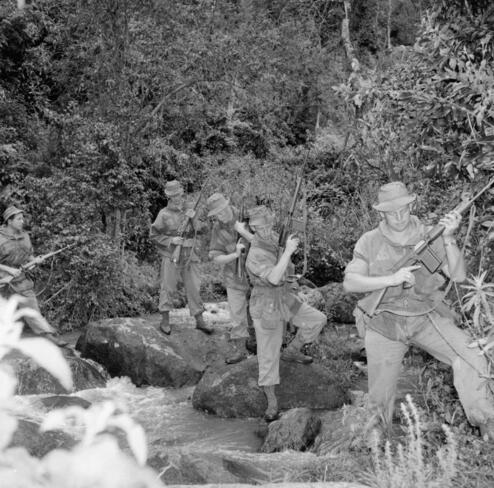
Header photo: British Army patrol crossing a stream during the Mau Mau rebellion. The soldiers carry a variety of weapons, including the X8E1 (Belgian-made 7.62mm FN FAL) (1st and 2nd soldiers from right); the 9 mm Sten Mk5 and the Lee Enfield .303 Rifle No. 5 (4th and 5th soldiers). Weapons are identified from the book The FN FAL Battle Rifle, by Bob Cashner
Discover More
This remarkable story is only one chapter in the long and often forgotten history of Africa's connections with the wider world. Explore more articles on African kingdoms, Pan-African history, global cultural exchanges and the extraordinary individuals whose lives linked Africa with Europe, Asia and the Americas. Every story opens another door into Africa.