Idi Amin: The Eight Years That Broke Uganda
Remarkable Africans · The ones who broke the promise
Idi Amin: The Eight Years That Broke Uganda
He came to power promising to return Uganda to ordinary Africans. He overthrew an elected president, purged the army, expelled tens of thousands of Asians, destroyed businesses, murdered opponents, turned the security services into instruments of fear, and eventually dragged Uganda into a disastrous war with Tanzania. When he finally fled, the country he left behind was economically wrecked and politically shattered.
There are dictators who become myths because they were extraordinary. There are others who become myths because the truth is almost too ordinary to believe: a soldier takes power, surrounds himself with frightened men, eliminates anyone who might challenge him, rewards loyalty, destroys institutions, and discovers that fear can keep a government alive long after competence has disappeared.
Idi Amin belongs in the second category.
He has been turned into a caricature in the decades since his fall — the enormous Ugandan general, the medals, the eccentric speeches, the alleged cannibalism, the grotesque stories repeated until nobody remembers where they came from.
Some of the stories are impossible to verify. Some are almost certainly inventions. And concentrating on them can actually make the history less frightening.
Because the documented record is bad enough.
The soldier
Idi Amin Dada was born around 1925 in north-western Uganda, although his exact birth date is uncertain. He came from the Kakwa people and was raised in a Muslim family.
He joined the King's African Rifles, the British colonial army, in 1946.
That mattered.
The colonial army was one of the few institutions in British East Africa in which an African man could build a career with access to weapons, discipline and authority. Amin was physically formidable and became a successful soldier. He served in Kenya during the British campaign against the Mau Mau uprising.
By independence in 1962 he had risen to become one of the most senior African officers in the new Ugandan army.
Uganda's first prime minister, Milton Obote, initially regarded him as useful.
That relationship would eventually destroy both men.
Independence did not make the army democratic
Uganda became independent from Britain in 1962. Milton Obote became prime minister, while Kabaka Edward Mutesa II — the king of Buganda — became president.
The arrangement did not last.
Political rivalry, regional divisions and disputes over power increasingly militarised Ugandan politics. Amin rose rapidly through the army and became one of Obote's most important military men.
But Amin was also building his own base.
He recruited heavily from northern and West Nile communities, including his own Kakwa people, and developed personal loyalties inside the armed forces. Obote increasingly distrusted him.
Then came the break.
25 January 1971
While Milton Obote was attending a Commonwealth conference in Singapore, Idi Amin seized control of Uganda. Troops took strategic installations in Kampala and elsewhere. Obote was locked out of his own country.
Amin presented the coup as a liberation.
He promised elections. He promised an end to corruption. He promised a government for ordinary Ugandans.
There was genuine relief in parts of the population. Obote had become increasingly authoritarian and unpopular, and Amin initially benefited from the fact that many Ugandans wanted change.
Foreign governments also recognised the new regime.
Declassified American records from 1971 describe the overthrow plainly: Amin had overthrown President Milton Obote, and the purge of Obote's supporters in the army had already produced large-scale killing and disorder.
The United States intelligence assessment warned that the Ugandan army had become an unruly force that was terrorising the country.
The revolution lasted about as long as it took Amin to discover that nobody was going to stop him.
The first purge
Amin's first enemies were inside the army.
Obote's supporters, particularly soldiers from the Acholi and Lango communities, were regarded as a threat. Units were disarmed. Men disappeared. Others were taken away and killed.
In the months after the coup, Amin's government increasingly relied upon the army, military police and newly created intelligence organisations.
Among them were the Public Safety Unit and, later, the State Research Bureau.
These were not ordinary police agencies.
They became instruments of political repression.
Human Rights Watch has cited evidence that Amin's security forces killed approximately 10,000 Ugandans during his first year alone. Estimates for the total number killed during his eight years vary enormously, from roughly 100,000 to 500,000. Some widely repeated accounts give a figure around 300,000.
The honest answer is that nobody knows the exact number.
There was no functioning independent system recording every disappearance.
That uncertainty should not be mistaken for doubt about the killings.
The man who disappeared across the border
Milton Obote established himself in Tanzania after the coup.
President Julius Nyerere refused to recognise Amin as Uganda's legitimate ruler and allowed Ugandan exiles to organise against him.
Amin accused Tanzania of preparing an invasion.
Nyerere accused Amin of being a military dictator who had overthrown a government he considered legitimate.
The two men would eventually go to war.
But before that, Amin had to deal with another problem: Uganda's extraordinary ethnic and commercial diversity.
The Asians
This is one of the most important parts of the Amin story because it is sometimes reduced to a simple sentence: “Amin expelled the Indians.”
The reality was larger.
Uganda had a substantial South Asian population whose presence dated back to British colonial rule. Many had originally arrived as labourers, railway workers and traders. By independence, the community included merchants, industrialists, professionals and business owners.
There were also Ugandan citizens of Asian origin.
Amin increasingly portrayed the Asian population as economically privileged, insufficiently integrated and responsible for Uganda's economic problems.
There were genuine inequalities in colonial Uganda. But Amin's answer was collective punishment.
Amin announces that Asian holders of British passports must leave Uganda within ninety days.
The order expands. The expulsion comes to encompass the Asian community far beyond British passport holders, including people with Ugandan citizenship.
Thousands leave. Britain accepts tens of thousands of Ugandan Asians holding British passports. Others go to Canada, India, Pakistan and elsewhere.
The British National Archives preserves the Cabinet discussions from August 1972. The documents show British officials understood that Amin's action was creating a major humanitarian and diplomatic crisis. Britain eventually organised the resettlement of approximately 27,000 people.
Many of those expelled arrived in Britain with almost nothing.
Many would later build extraordinarily successful lives.
Uganda, meanwhile, lost a large part of the commercial class on which its economy depended.
Amin claimed he was giving Uganda back to Ugandans. What he actually gave Uganda was an economic vacuum.
The businesses were handed out
The confiscated businesses were not magically transformed into successful African enterprises.
They were frequently handed to military officers, political allies and people connected to the regime.
Many had no experience running them.
Machinery was neglected. Supply chains broke down. Skilled workers disappeared. Capital fled. Agricultural production declined. Industrial output collapsed.
The policy was presented as economic liberation.
It became economic destruction.
By the end of Amin's rule, Uganda's economy was in ruins.
Britain, Israel and the dictator
There is another uncomfortable part of the story.
Amin was not initially treated by the West as an untouchable monster.
His early regime had relationships with Britain and Israel. Israeli military advisers had been important to Uganda, and Amin initially cooperated with them.
Then his foreign policy changed dramatically.
He moved towards Libya and Muammar Gaddafi, expelled Israeli personnel and increasingly adopted a fiercely anti-Israeli position.
His relationship with Britain deteriorated as well, particularly after the Asian expulsion and the nationalisation of British interests.
This is important because it destroys another simplistic version of the story: Amin was not simply a puppet of one foreign power from beginning to end.
He shifted alliances according to his interests.
Britain, Israel, Libya, the Palestinians and the wider Arab world all became part of his increasingly erratic foreign policy at different moments.
The killings became systematic
By the middle of the 1970s, fear had become part of ordinary Ugandan life.
People disappeared.
Government opponents were arrested. Soldiers suspected of disloyalty vanished. Intellectuals, politicians, religious leaders and ordinary citizens could be targeted.
Among the most famous victims was Benedicto Kiwanuka, Uganda's first Chief Justice and a former prime minister.
He was arrested in 1972 and disappeared. His body was never publicly accounted for in a way that could provide his family with justice.
Then there was Janani Luwum, the Anglican Archbishop of Uganda.
Luwum had become increasingly outspoken about the regime's abuses.
On 16 February 1977 he was arrested together with two government ministers, Erinayo Wilson Oryema and Charles Oboth Ofumbi.
All three were soon reported dead in what the government claimed was a road accident.
Few people believed it.
The official explanation collapsed under the weight of the circumstances.
The significance of Luwum's murder was enormous.
He was not an obscure political opponent. He was the head of Uganda's Anglican Church and one of the country's most respected public figures. His killing demonstrated that even a man of immense religious and international standing was not beyond the reach of the security apparatus.
Human Rights Watch lists both Kiwanuka and Luwum among the prominent Ugandans who lost their lives during Amin's rule.
The State Research Bureau
The name sounds bureaucratic.
It was anything but.
The State Research Bureau became one of Amin's principal instruments of terror.
Its men operated with extraordinary latitude. Detention, interrogation and killing became intertwined with political control.
There was no reliable judicial protection for someone once the security services decided he was an enemy.
That is why the final death toll can never be reconstructed perfectly.
People were not necessarily registered as prisoners. Some disappeared from villages. Some disappeared from military barracks. Some were taken from their homes.
The absence of a death certificate is not evidence that nobody died.
Entebbe
Then came the event that made Idi Amin internationally famous.
On 27 June 1976, Air France Flight 139 was hijacked after leaving Tel Aviv and was eventually taken to Entebbe Airport in Uganda.
The hijackers included members of the Popular Front for the Liberation of Palestine and German militants.
Amin welcomed the hijackers.
The hostages were held in the old terminal at Entebbe.
Ugandan soldiers guarded the area.
The Israeli government eventually authorised an extraordinary rescue operation.
On the night of 3–4 July 1976, Israeli commandos flew more than 2,500 miles to Uganda and attacked the airport.
The rescue became one of the most famous special-forces operations of the twentieth century.
But the Ugandan side of the story is often reduced to Amin standing around in a ridiculous uniform while Israeli soldiers perform the real action.
The reality was uglier.
Ugandan forces fought the Israeli commandos. Several Ugandan soldiers were killed. The Israeli operation destroyed Ugandan MiG aircraft on the ground to prevent pursuit.
The hostages were rescued, with several deaths including one Israeli commando, Lieutenant Colonel Yonatan Netanyahu.
One hostage, Dora Bloch, an elderly British-Israeli woman who had been taken to hospital before the rescue because she had become ill, was left behind.
Ugandan authorities subsequently killed her.
Her murder became an international scandal and further poisoned relations between Amin and Britain.
Entebbe made Amin look ridiculous to the outside world. Inside Uganda, the consequences were much darker.
After the raid, Amin's security forces carried out reprisals against people believed to have assisted Israel or opposed him. Kenyan citizens and others were targeted.
The operation humiliated Amin personally and demonstrated something strategically important: Uganda's government could not protect its own airport from a foreign commando raid.
The dictator begins to lose control
By the late 1970s Uganda was running out of money, productive capacity and political stability.
The army remained powerful but increasingly fragmented.
Amin's habit of promoting loyalists and purging suspected opponents had destroyed professional military structures.
His government had become dependent upon personal loyalty.
That works until the people with guns decide the person at the top is no longer worth defending.
There were attempted plots and mutinies.
Some officers fled.
Others joined opposition movements.
The Ugandan exile community became increasingly organised outside the country, particularly in Tanzania.
And then Amin invaded Tanzania
Fighting erupts along the Uganda–Tanzania border. Ugandan forces cross into Tanzanian territory and occupy part of the Kagera region.
The exact sequence of events and who initiated every stage of the fighting remains debated, but declassified American records are clear about the broader picture: Amin's forces pushed into Tanzania while also attempting to suppress dissident Ugandan soldiers near the border.
Tanzania's President Julius Nyerere had spent years opposing Amin.
Now he had a justification to act.
Nyerere mobilised the Tanzanian People's Defence Force.
Ugandan exiles joined the war.
Amin expected that Tanzania would eventually retreat.
It did not.
The army that could not save him
By early 1979, the Ugandan military was collapsing.
Tanzanian troops and Ugandan exile forces advanced north.
Masaka fell in February.
Entebbe fell in early April.
American intelligence assessed that Amin's military situation was deteriorating steadily and that Libyan assistance might not be enough to save him.
Muammar Gaddafi sent troops and military assistance to Amin.
It was not enough.
Declassified U.S. records from March 1979 are remarkably blunt. They describe Amin's forces withdrawing in disarray and note that Tanzanian and Ugandan exile forces had already captured territory close to Kampala.
10–11 April 1979
Tanzanian and Ugandan exile forces enter Kampala. Amin's regime effectively collapses.
Amin flees Uganda. He eventually goes into exile, first in Libya and later permanently in Saudi Arabia.
The dictator who had once commanded an army of his own now depended upon foreign countries to give him somewhere to live.
He would never return to Uganda.
What the liberators found
The destruction was extraordinary.
American diplomatic reporting after the fall of Kampala described Uganda as an economic disaster area.
Industry was almost at a standstill.
Sugar refining had fallen to a fraction of its previous level.
Cement production had stopped.
Manufacturing had collapsed.
Agricultural production had fallen dramatically.
The country's foreign exchange reserves were almost exhausted.
And when Kampala finally fell, ordinary Ugandans looted the businesses associated with Amin and his supporters.
The rage had been building for eight years.
Amin did not leave Uganda poor because Uganda lacked resources. He left it poor because he destroyed the machinery that turned resources into an economy.
What happened to Amin?
He did not stand trial.
He did not answer publicly for the deaths of his opponents.
He did not face a tribunal over the Asian expulsion.
He did not face justice for Janani Luwum, Benedicto Kiwanuka, Dora Bloch or the thousands upon thousands of ordinary Ugandans who disappeared.
He lived in exile.
Eventually he settled in Saudi Arabia, where the government allowed him to remain.
He lived there for more than two decades.
He died in Jeddah on 16 August 2003.
He was about 78 years old.
He died without ever being tried for the crimes committed under his rule.
The cannibal story
This needs its own section because it has become inseparable from his name.
There have long been allegations that Amin ate human flesh or kept human heads and bodies as trophies.
Some witnesses made horrific claims. Stories circulated internationally. Journalists repeated them. Later books repeated the journalists.
And then popular culture turned them into fact.
The problem is simple:
There is no need to state as fact what cannot be established as fact.
Amin was responsible for widespread murder, disappearances, political repression, torture and collective punishment. Those crimes are documented.
Ugandans do not need a cannibalistic horror story invented or exaggerated around him to make those crimes sufficiently terrible.
The same applies to some of the more theatrical stories about his personality.
The historical Amin is actually more disturbing than the movie version because he was not a supernatural monster.
He was a human being who acquired state power, controlled armed men and used that power to destroy people he considered enemies.
That distinction matters.
If we turn dictators into monsters from another universe, we can reassure ourselves that they are fundamentally different from ordinary human beings. History teaches the opposite lesson.
Amin did not need supernatural cruelty. He needed soldiers, intelligence officers, prisons, political fear and a state that stopped protecting its citizens.
Was everything about Amin evil?
No.
And this is where serious history differs from propaganda.
Amin's initial overthrow of Obote was welcomed by many Ugandans because Obote's government had become authoritarian and deeply unpopular.
His rhetoric about restoring power to ordinary Africans resonated with people who had experienced the inequalities of colonial rule.
His Asian expulsion was also initially popular among sections of the African population who believed the economy had been dominated by a commercial minority.
That popularity was real.
It does not make the policy right.
Nor does it make the subsequent destruction of businesses, the confiscation of property or the expulsion of citizens defensible.
This is precisely why the history matters.
Dictators rarely begin by announcing: “I am going to destroy my country.”
They begin by identifying grievances that actually exist.
Then they offer themselves as the solution.
Then they remove the institutions that could remove them.
The price of eight years
The uncomfortable conclusion
Idi Amin did not destroy Uganda alone.
He inherited a state with deep regional, ethnic and institutional divisions. British colonial rule had left behind an army and political system in which access to power was unevenly distributed. Milton Obote's governments had already damaged Uganda's democratic institutions before Amin took over.
None of that excuses what followed.
Amin took an already fragile country and made the fragility far worse.
He turned the army into a political instrument.
He turned intelligence agencies into instruments of fear.
He turned citizenship into something that could be revoked by presidential decree.
He turned economic policy into patronage.
He turned political disagreement into a potential death sentence.
And finally he took a conflict with Tanzania and turned it into a war he could not win.
When his government fell, Uganda had to begin again.
But countries do not simply restart.
People who have disappeared do not return.
Businesses that have been destroyed do not immediately reopen.
Children who grow up under fear do not suddenly become citizens of a functioning democracy because the dictator has fled.
Institutions take generations to rebuild.
The most important thing about Idi Amin is not that he was monstrous. It is that he was human — and that ordinary institutions proved insufficient to stop him.
Why he belongs on this site
African independence is not supposed to be a collection of fairy tales about heroic leaders.
Independence created enormous possibilities across Africa. It also created new states carrying colonial borders, colonial armies, weak institutions and economies designed for extraction rather than balanced development.
Uganda shows what happens when those weaknesses collide with personal dictatorship.
Amin was not colonialism.
He was not the whole explanation for Uganda's problems.
But he was one of the clearest demonstrations of how quickly political independence can become meaningless when a government no longer accepts limits on its own power.
And that is why his story belongs here.
Not because he was a cannibal.
Not because he was a madman from a horror film.
Not because Hollywood needed a villain.
But because he was a soldier who seized an independent African state, discovered that fear was an extraordinarily effective political instrument, and left behind a country that had been economically and institutionally broken.
Eight years were enough.
Sources & further reading
- Human Rights Watch — Idi Amin Dies Without Facing Justice
- UK National Archives — Ugandan Asians
- UK National Archives — 50th Anniversary of the Arrival of Ugandan Asians
- U.S. Office of the Historian — 1971–72 U.S. assessment of Uganda under Amin
- U.S. Office of the Historian — Uganda–Tanzania fighting, 1978
- U.S. Office of the Historian — The precarious situation in Uganda, 1979
- U.S. Office of the Historian — Amin's fall may be imminent, March 1979
- JSTOR — Slow Poison: Idi Amin, Yoweri Museveni, and the Making of the Ugandan State
- African Studies — The British Government, Idi Amin and the Expulsion of British Asians from Uganda
- Anna Madgigine Jai Kingsley — the Wolof girl who defended her freedom
- African radio, live — the whole continent on one page
- Dr Kwame Nkrumah
Verified: 5 September 2026.
This article was checked against declassified United States government diplomatic and intelligence records, Human Rights Watch material, the UK National Archives and published historical scholarship. The date of Amin's 1971 coup, the 1972 expulsion of Uganda's Asian population, the killings of prominent Ugandans including Benedicto Kiwanuka and Janani Luwum, the 1976 Entebbe crisis, the Uganda–Tanzania war and Amin's fall in April 1979 are established historical events. Victim totals are deliberately presented as estimates because the available historical sources do not provide a single verified death toll. Figures concerning the Asian population likewise vary according to whether sources count citizens, British passport holders or the wider South Asian population. Claims of cannibalism and other sensational stories surrounding Amin are not presented as established facts where the evidence is insufficient. The purpose of this article is to document the historical record rather than reproduce later mythology.
Last Radio Message by Amin, during Uganda-Tanzania war 1979
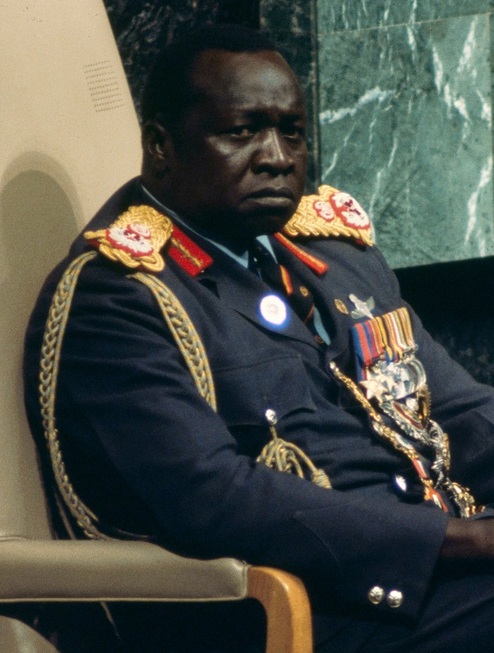
By Bernard Gotfryd - Amin in the UNGA, 1975. This image is available from the United States Library of Congress's Prints and Photographs divisionunder the digital ID gtfy.00132.This tag does not indicate the copyright status of the attached work. A normal copyright tag is still required. See Commons:Licensing., Public Domain, Link
Discover More
This remarkable story is only one chapter in the long and often forgotten history of Africa's connections with the wider world. Explore more articles on African kingdoms, Pan-African history, global cultural exchanges and the extraordinary individuals whose lives linked Africa with Europe, Asia and the Americas. Every story opens another door into Africa.