Agostinho Neto and 11 November 1975: The Independence That Arrived Already at War
Remarkable Africans · The independence that never arrived quietly
Agostinho Neto and 11 November 1975: The Independence That Arrived Already at War
A poet and doctor declared Angola independent at midnight while South African armoured columns were driving north, Zairean troops were being destroyed twelve miles from his capital, the CIA was funding two of his rivals, and Cuban soldiers were landing at his airport. Three movements declared independence that week. The war that followed ran for twenty-seven years and killed as many as a million people. And eighteen months in, Neto's own government carried out a purge of its own supporters that Angola still cannot officially count.
In our article on Njinga we followed a queen who spent thirty-nine years keeping a state alive against Portugal in the seventeenth century. Three hundred years later, Angola was still fighting the same country.
Portugal was the first European power into that part of Africa and the last one out. Luanda was founded in 1575. Portuguese rule ended in 1975.
Four hundred years, ended not by an African victory in the field but by a group of Portuguese army captains overthrowing their own government in Lisbon.
And what came next was worse than what came before, by any measure you choose.
The colony
Portuguese Angola was not a light-touch administration. Under the Estado Novo it was designated an overseas province of Portugal — the fiction being that there was no colony at all, only a single multicontinental nation.
Underneath the fiction was forced labour. The contrato system supplied workers to coffee and cotton plantations and to the mines under conditions that the International Labour Organization and successive foreign observers described in terms difficult to distinguish from bondage.
Angolans could apply to become assimilados — legally Portuguese, with rights — by demonstrating literacy in Portuguese, Christian practice and an appropriate income. By the late colonial period, after four centuries, roughly one per cent of the African population had qualified.
Meanwhile Lisbon encouraged Portuguese settlement. The white population of Angola grew from tens of thousands to well over three hundred thousand by the early 1970s, taking the best land, the towns and the administration.
Two facts to hold together. Angola had oil, diamonds, iron, coffee and some of the best farmland in Africa. And it had one of the lowest African literacy rates on the continent at independence, a few dozen university graduates from its entire African population, and almost no African doctors, engineers or administrators.
That was not an accident of underdevelopment. It was the design.
1961: the year it started
Militants attack the police headquarters and prisons in Luanda, trying to free political prisoners. The attack fails. This date is Angola's official start of the armed struggle, and is commemorated as a national holiday.
A rising in the coffee districts of the north, led by Holden Roberto's UPA. Portuguese settlers are killed, and so are large numbers of Ovimbundu contract labourers brought north to work the plantations — Africans killed by Africans in the first week of the war.
Portuguese reprisals. Aircraft, napalm, mass killing in the northern districts. The death toll is measured in tens of thousands. Hundreds of thousands flee across the border into the Congo.
Note what happened in the first six weeks. Settlers massacred. Migrant African workers massacred by the insurgents. Villages destroyed from the air by the colonial power.
Everything that would define the next forty-one years was present in the first six weeks.
Three movements, three ethnic bases, three foreign sponsors
This is the structural fact that explains Angola, and it is usually reduced to a Cold War cartoon.
Each had a real constituency. Each had a foreign patron with its own agenda. None could win alone, and none would accept losing.
And there was a fourth conflict inside the third: Cabinda, the oil-rich enclave separated from the rest of Angola by Congolese territory, with its own separatist movement that has never gone away.
Angola did not fracture because independence went wrong. It was already three countries fighting each other in 1961, and independence simply removed the one thing they had in common.
Neto
António Agostinho Neto was born on 17 September 1922 at Kaxikane, in Icolo e Bengo province, the son of a Methodist pastor and a teacher.
He was, by any standard, an extraordinary product of a system designed to produce nobody.
He worked in the colonial health service, then won a scholarship to study medicine in Portugal — first at Coimbra, then Lisbon. He qualified as a doctor. He married Maria Eugénia da Silva, a Portuguese woman, in 1958.
And he was a poet. A serious one. His work is central to Angolan literature and was translated across the Portuguese-speaking world while he was still in prison.
The Portuguese secret police, the PIDE, arrested him repeatedly through the 1950s. In 1960, when he was arrested at his practice, villagers marched to demand his release and Portuguese troops fired on them. He was deported to Cape Verde, then to Lisbon, then placed under house arrest, and escaped in 1962.
By 1962 he led the MPLA. He would lead it for seventeen years.
It is worth pausing on the shape of that life, because it is genuinely unusual among the leaders on this website.
Not a soldier. Not a chief's son. A pastor's son from a rural district who became a physician in the metropolis of the empire that ruled him, wrote poetry good enough to outlast the politics, and then led a guerrilla movement for seventeen years.
25 April 1974
Here is the part that Angolan, Mozambican and Guinean national narratives all handle carefully, because it complicates the story of liberation won by struggle.
Portugal did not lose the war in Angola militarily. By 1974 the Portuguese army held the towns and most of the country, and the MPLA in particular was in poor shape — divided, pushed to the margins, with Neto facing serious internal challenges.
What ended the empire was that Portugal itself broke. On 25 April 1974, Portuguese officers — exhausted by thirteen years of simultaneous colonial wars in Angola, Mozambique and Guinea-Bissau — overthrew the dictatorship in Lisbon.
The Carnation Revolution was made by soldiers who had been fighting Africans and had concluded the war could not be won and was not worth winning.
That is not a small thing to say and it does not diminish the liberation movements. Thirteen years of guerrilla war across three territories is what broke the Portuguese army's willingness to continue. The African wars caused the Lisbon coup.
But the sequence matters: the decisive event happened in Europe, it happened suddenly, and it left Angola with about eighteen months to build a state that nobody had built.
Alvor, and the collapse
The Alvor Agreement. Portugal, the MPLA, the FNLA and UNITA agree a transitional government of all three movements plus Portugal, integrated armed forces, elections, and independence on 11 November 1975.
It never had a chance. The three movements had spent a decade fighting each other as well as Portugal. The transitional government functioned for weeks.
By March there was fighting in Luanda. By July the MPLA had driven the FNLA out of the capital, and UNITA had withdrawn to the central plateau. Angola divided along the lines of the three movements' bases, and everyone began preparing for November.
Meanwhile the Portuguese settler population left — several hundred thousand people, in a matter of months, taking what they could and in many documented cases destroying what they could not. Vehicles were driven into the sea. Machinery was sabotaged. The technical and administrative class of the entire country vanished in a single year.
The foreign armies
Now count who was in Angola in the autumn of 1975.
The United States authorises a covert operation to fund and arm the FNLA and UNITA. Weapons and money move through Zaire.
South Africa launches Operation Savannah. Armoured columns cross from South West Africa — today's Namibia — and drive north with astonishing speed, hundreds of kilometres in weeks, aiming to take Luanda before independence day and install UNITA and the FNLA.
Fidel Castro launches Operation Carlota. Cuban specialists and special forces begin flying in. Cuba's commitment will eventually run to tens of thousands of troops over more than a decade.
Zairean regular troops, Portuguese volunteers and European mercenaries assemble with the FNLA north of Luanda for the final push on the capital.
Four foreign states with soldiers or paid proxies inside Angola before it had a flag.
Quifangondo
The independence of Angola was decided by an artillery duel on a stretch of low ground about twelve miles north of Luanda, in the days immediately before 11 November.
An FNLA force of a few thousand — with Zairean commando battalions, mercenaries, armoured vehicles and a small South African artillery detachment — advanced on the capital.
Facing them was a smaller MPLA force with Cuban artillerymen and advisers, and something the attackers had not expected: BM-21 multiple rocket launchers.
The attack was destroyed. The valley was afterwards called by a name meaning the road of death. The FNLA never recovered as a fighting force.
Accounts differ on the exact date — you will see 8, 9 and 10 November in reputable sources — but not on the outcome.
Hold the picture for a moment.
The apartheid South African Defence Force and the Central Intelligence Agency were, in November 1975, on the same side, trying to install a government in an African capital.
They were stopped by Cubans.
Whatever else you conclude about the Angolan war, that is the sequence, and it explains why Cuba's standing in much of Africa has never resembled its standing in Washington.
11 November 1975
The Portuguese High Commissioner left on 10 November without handing power to anyone, because there was no one everyone agreed to hand it to.
At midnight, in Luanda, Agostinho Neto proclaimed the People's Republic of Angola.
The same week, in Huambo, the FNLA and UNITA proclaimed their own Democratic People's Republic of Angola.
Two governments, one country, day one.
Angola has never had an independence day and a peace day. It has only ever had the first.
The recognition war
What followed was a diplomatic battle across Africa that we have covered elsewhere on this site from the Nigerian end.
The OAU was split roughly in half over which Angolan government to recognise. At the extraordinary summit in Addis Ababa in January 1976, Nigeria's General Murtala Mohammed read out the substance of a letter from President Ford urging Nigeria not to recognise the MPLA, and demolished it in public — arguing that a United States which had chosen white minority rule over African self-determination had disqualified itself from advising Africa about its friends. He asked the assembly to seat Agostinho Neto's government.
The OAU recognised the MPLA.
Murtala Mohammed was assassinated thirty-three days later.
In the United States, the revelation that Washington was fighting alongside apartheid South Africa in Angola produced a revolt in Congress. Funding for the covert operation was cut off, and the Clark Amendment barred further American assistance to Angolan factions — a prohibition that stood for a decade.
South Africa withdrew its columns in early 1976, having been publicly identified, and having lost.
The MPLA had won the state.
27 May 1977
Eighteen months later the new government did something that Angola has still not honestly reckoned with, and this is the section that makes this article worth writing.
Nito Alves was a former guerrilla commander, a hero of the war, Minister of Internal Administration, and a member of the MPLA central committee. He was young, from a poor background, and enormously popular in Luanda's working-class districts, above all in Sambizanga.
His criticism of Neto's government was specific and it was from the left: that the leadership was dominated by mixed-race and white Angolans and educated elites at the expense of the poor black majority, that corruption had already set in, and that the revolution was being betrayed by the people running it.
In May 1977 Neto had Alves and José Van-Dúnem expelled from the central committee, and told a rally that there could be no factions — that whoever disagreed should get out.
Alves's supporters storm São Paulo prison to free detained allies, seize the national radio station, and call a mass demonstration in central Luanda. Seven senior officials are seized; six are killed.
Cuban troops loyal to Neto retake the palace, then the radio station, then the barracks of the 8th Brigade. The rising is over within hours.
Neto goes on television and states that there will be no trials and no pardons. What follows is not the suppression of a coup. It is a purge.
Troops, including Cuban units with tanks and armoured vehicles, went into Sambizanga. Scores of houses were flattened. There was indiscriminate shooting over days. Anyone connected to Alves — including, in one documented case, everyone associated with a neighbourhood football club — was hunted.
Then it spread outwards and lasted for two years. Arrests, torture, detention camps, executions. The victims were overwhelmingly MPLA people: young party activists, students, intellectuals, soldiers, the generation that had made the revolution.
Alves and Van-Dúnem were killed. So was Sita Valles, a young Portuguese-Angolan communist, and she was pregnant.
A liberation movement that had been in power for eighteen months killed an unknown number of its own young revolutionaries and has spent forty-nine years declining to count them.
Angolans who campaign for an accounting of 27 May are still harassed today. A teenager who happened to share Nito Alves's name and supported a victims' association has reported death threats. Half a century on, this remains the most dangerous subject in Angolan public life.
Neto's death, and what followed
Agostinho Neto died on 10 September 1979 in Moscow, of cancer, aged fifty-six. He had been head of state for less than four years.
His body was embalmed and placed in a mausoleum in Luanda. His birthday, 17 September, is Angola's National Heroes' Day.
He was succeeded by José Eduardo dos Santos, who was thirty-seven.
Dos Santos held power for thirty-eight years.
And the war went on the entire time.
Twenty-seven years
South Africa's repeal-era wars. UNITA is armed by Pretoria and, after the Clark Amendment is repealed in 1985, by Washington. Savimbi is received at the White House. Angola's south becomes the battlefield of the South African Border War, culminating in the enormous set-piece fighting around Cuito Cuanavale in 1987–88.
Negotiated settlement. South African and Cuban withdrawal. Namibian independence in 1990. A ceasefire in Angola in 1991.
UN-supervised elections. The MPLA and dos Santos lead. Savimbi rejects the result, and UNITA returns to war. What follows is the bloodiest phase of the entire conflict — worse than everything the Cold War produced.
The war is now funded by commodities rather than superpowers. UNITA sells diamonds; the government sells oil. This is where the phrase blood diamonds comes from. Angola becomes one of the most heavily mined countries on earth.
Jonas Savimbi is killed by government troops at Lucusse in Moxico province. Six weeks later UNITA signs the Luena Memorandum. The war ends because one man died.
Estimates of the total dead across the twenty-seven years generally run from around five hundred thousand to a million, with roughly four million people displaced. In 2002 the majority of Angolans had no access to clean drinking water and something close to a third of children were dying before the age of five.
Cuito Cuanavale deserves its own note, because the argument about it is genuinely unresolved and both sides overclaim. Southern African and Cuban accounts hold that the battle broke the South African Defence Force's aura of invincibility and forced the negotiations that produced Namibian independence and hastened the end of apartheid. South African accounts hold that their forces were never defeated in the field and that withdrawal was a political decision. What is not in dispute is that Namibia became independent in 1990, and that the Cubans went home.
What was actually built
After 2002 came the oil.
Angola became one of Africa's largest producers. Luanda filled with cranes, Chinese construction loans and glass towers, and became for several years the most expensive city in the world for foreign workers.
And the money went where the power was.
Dos Santos ruled for thirty-eight years and his family became extraordinarily wealthy. His daughter Isabel became, by widely reported accounts, Africa's richest woman; the Luanda Leaks documents published in 2020 detailed how state assets and contracts had been routed to family-linked companies. She denies wrongdoing. Angolan and Portuguese authorities have pursued the matter through the courts.
Meanwhile most Angolans stayed poor. Inequality widened through the boom rather than narrowing.
Dos Santos stood down in 2017 and died in 2022. João Lourenço became president, promised an anti-corruption reckoning, removed the dos Santos family from its positions, and has since been criticised for a campaign that has fallen well short of the transformation it promised. He was re-elected in 2022; his term runs to 2027.
In November 2025 Angola marked fifty years of independence.
The MPLA has governed for every one of them.
The uncomfortable part
An honest article has to hold several things at once here, and refuse the temptation to pick a favourite.
Portugal ran a four-hundred-year extractive colony that used forced labour into the 1960s, left a country of six million people with almost no trained professionals, and bombed villages from the air when they resisted. Nothing that followed transfers the responsibility for that.
The United States armed two Angolan movements and encouraged an apartheid invasion of an African country, and its own Congress stopped it out of embarrassment rather than principle.
South Africa invaded a sovereign state to install a client government, and then fought there for thirteen more years.
Cuba's intervention genuinely saved Angolan independence from a South African–backed takeover, and Cuban troops then helped carry out a massacre of Angolan leftists in Sambizanga.
Jonas Savimbi took money and weapons from apartheid South Africa to fight other Africans, restarted the war in 1992 after losing an election he had agreed to hold, and is remembered by parts of the Ovimbundu as the only leader who ever represented them.
And Agostinho Neto — the poet, the doctor, the man whose face is on the money — presided over 27 May 1977 and said in public that there would be no trials.
None of these cancel out. They are all true simultaneously, and any version of Angola that leaves out two or three of them in order to make a point is not history. It is recruitment material.
Why this belongs on this site
Because Angola is the strongest case anywhere on the continent against the idea that independence is a moment rather than a process, and against the idea that colonialism ends when the flag changes.
The Portuguese left in 1975. The war ran to 2002. That is twenty-seven years of independent Angolans killing each other with weapons supplied by the Soviet Union, the United States, South Africa, China and eventually by their own mineral exports.
And the structure underneath was laid before 1975. A colony that trained nobody. A colonial economy built on extraction. Three liberation movements organised along ethnic lines because the colony had governed along ethnic lines. And a moment of transition so compressed that there was no time to build anything before the fighting started.
Independence did not fail in Angola. Independence arrived into a situation that had been engineered, over centuries, to make success improbable — and then four foreign powers arrived to make it worse.
That is not an excuse for what Angolans then did to each other. It is the context in which they did it, and both halves are required.
What remains
There is a mausoleum in Luanda holding an embalmed poet.
There is his face on the kwanza, his name on the university, and his birthday as National Heroes' Day.
There are his poems, which are better than most things politicians leave behind and which will outlast the mausoleum.
There is a valley twelve miles north of Luanda called the road of death, where Angola's independence was decided by rocket artillery in the days before the flag went up.
There are, somewhere, an unknown number of graves from 1977 and 1978 that nobody has counted and no government has looked for.
There are still landmines in the ground.
And there is a party that came to power on 11 November 1975 and has not left, on the fiftieth anniversary of a country that was born already at war.
Connected reading & sources
- Njinga of Ndongo and Matamba — the queen, the myths, and the slave trade nobody mentions
- Murtala Mohammed — the Nigerian general murdered in his own car
- Mobutu Sese Seko — the man who killed African independence
- The minerals still leave
- Thomas Sankara — the African revolution murdered by his best friend
- The long road to freedom — the leaders who paid the highest price
- U.S. Office of the Historian — The Angola Crisis, 1974–75
- Project MUSE — review of Lara Pawson, In the Name of the People: Angola's Forgotten Massacre
- Review of African Political Economy — 'When freedom died' in Angola: Alves and after
- Maka Angola — time for truth and reconciliation over 27 May 1977
- Angola at 50 — resources, unrest and a political crossroads
- Chr. Michelsen Institute — Angola after dos Santos
- BTI 2026 — Angola country report
Verified: 7 September 2026.
Checked against United States Office of the Historian material on the Angola crisis of 1974–75, published scholarship on Operation Savannah and Operation Carlota, Lara Pawson's In the Name of the People: Angola's Forgotten Massacre and its academic reviews, work by Dalila Cabrita Mateus and Álvaro Mateus on the 1977 purge, Maka Angola's reporting, the Chr. Michelsen Institute's anthology on post-dos Santos Angola and the 2026 Bertelsmann Transformation Index country report. The dates of the Luanda attacks of 4 February 1961 and the northern rising of 15 March 1961, the Carnation Revolution of 25 April 1974, the Alvor Agreement of 15 January 1975, the launch of Operation Savannah on 14 October 1975 and Operation Carlota on 4 November 1975, the proclamation of independence on 11 November 1975, the rising and purge beginning 27 May 1977, Neto's death on 10 September 1979, the killing of Jonas Savimbi on 22 February 2002 and the Luena Memorandum that followed are as recorded. Where the record is contested it is stated as contested: accounts differ on the exact date of the battle at Quifangondo; estimates of the dead in the 1977–79 purge range from several thousand to figures approaching eighty thousand and no official count has ever been published; whether the events of 27 May 1977 constituted an attempted coup is disputed between the Angolan government's account and those of survivors; and the military and political significance of Cuito Cuanavale remains a matter of active disagreement between Cuban, Angolan and South African accounts. Total civil war casualties are given as a range because no reliable single figure exists. Allegations concerning the business affairs of members of the dos Santos family are the subject of ongoing legal proceedings and are denied by those concerned; nothing here should be read as a finding against any living person.
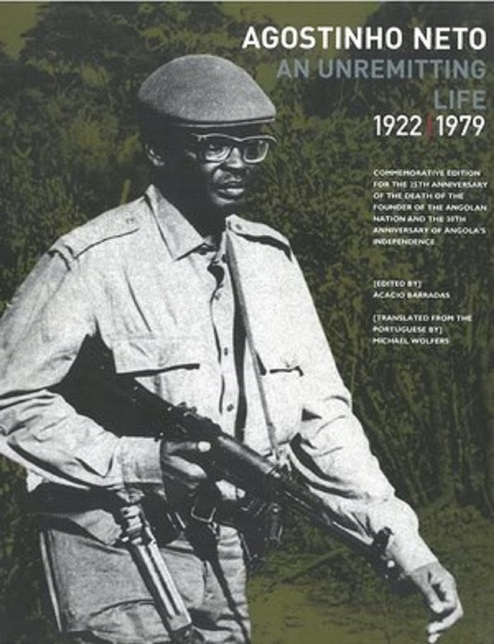
Header photo: Agostinho Neto as a Guerilla Fighter (public domain)
Discover More
This remarkable story is only one chapter in the long and often forgotten history of Africa's connections with the wider world. Explore more articles on African kingdoms, Pan-African history, global cultural exchanges and the extraordinary individuals whose lives linked Africa with Europe, Asia and the Americas. Every story opens another door into Africa.