1896: The Year Britain Took Kumasi and Germany Took Yendi
Remarkable Africans · The kingdoms that went under in the same year
1896: The Year Britain Took Kumasi and Germany Took Yendi
In January, a British force walked into Kumasi without a shot being fired and arrested the Asantehene. In December, a German force fought the Kingdom of Dagbon on a hillside south of Yendi and burned its capital. Two of West Africa's oldest states, six hundred kilometres apart, taken by two different empires inside eleven months. Nobody planned it together. A rule agreed in Berlin twelve years earlier made it inevitable — and then the two empires sat down in 1899 and divided the results.
Take a map of what is now Ghana and put two pins in it. One at Kumasi, in the forest. One at Yendi, on the northern plains. Six hundred kilometres apart, two entirely separate states, two languages, two religions, two military traditions, no shared border and no alliance.
In 1896 both were independent. By the end of that year neither was.
This is not a coincidence, and it is not a conspiracy either. It is what happens when the rules of an entire continent are written in a European conference room and then handed to men with rifles.
The rule that made it a race
At the Berlin Conference of 1884–85, the European powers agreed how African claims would be recognised. The principle that mattered was effective occupation.
A treaty signed with an African ruler counted for nothing on its own. A line drawn on a map counted for nothing. What counted was soldiers, administrators and flags physically present on the ground.
Read that as an African king would have read it, if anyone had told him.
Europe had just agreed, among themselves, that the way to own your country was to occupy it before another European did. Not to negotiate with you. Not to buy it. To arrive.
Every European officer in West Africa in the 1890s was operating under a deadline that no African ruler had been informed of, competing against other Europeans rather than against the kingdoms they were invading.
By the mid-1890s the interior of West Africa was the last unclaimed prize. Britain was pushing north from the Gold Coast. Germany was pushing north from Togoland. France was coming down from the Sahel and had already taken Samory Touré's war to the west.
Between them sat two of the most substantial states in the region.
The two kings who said no
Both kingdoms were offered the same thing, and both refused it.
Two kings, unknown to each other, arriving independently at the same answer within three years.
Both were then invaded within the same twelve months.
January 1896: Kumasi, without a battle
Britain needed a reason, and found one in an unpaid indemnity from a war fought two decades earlier under the Treaty of Fomena. There were supplementary justifications about human sacrifice. The real reason was the French in Côte d'Ivoire, the Germans in Togoland, and a hinterland that was about to be claimed by somebody.
An expeditionary force leaves Cape Coast under Colonel Sir Francis Scott — British and West Indian troops with Maxim guns and modern artillery, accompanied by a levy of local allies commanded by Major Robert Baden-Powell.
The force reaches Kumasi and meets no serious opposition. Prempeh I has assessed the strength of the invading column and ordered his people not to resist, to avoid the destruction of the capital and the slaughter of his people.
In a public ceremony in Kumasi, the Asantehene submits — together with the Queen Mother Nana Yaa Akyaa, his father, and senior chiefs. He is forced to sign a treaty of protection, and then arrested.
Around fifty relatives, chiefs and courtiers are arrested with him and marched to the coast. The British demand the Golden Stool. It is not produced — custodians have hidden it, and it is never found.
Prempeh I was held at Elmina Castle, then moved to Freetown in Sierra Leone, and finally to the Seychelles.
He was released and returned to Kumasi in 1924.
Twenty-eight years in the Indian Ocean, for a king who told his army not to fight.
There is a version of this story in which Prempeh was weak. It is wrong, and it was wrong at the time. He had spent five years refusing, appealing, negotiating and sending embassies. When a force with Maxim guns arrived at his capital, he made a judgement that his people mattered more than his throne — and he protected the one thing that could not be replaced, which was the Golden Stool.
Britain got Kumasi in a morning and never got the Stool at all.
December 1896: Yendi, with a battle
Eleven months later, at the other end of the same territory, a different empire tried the other method.
When Andani II refused Gruner passage in May, the German governor of Togoland, August Köhler, attached a military officer to the next attempt. The campaign against Dagomba is logged in the German colonial record as running from 29 September to 11 December 1896.
The column burned Bimbilla on 30 November and reached Adibo, on the road south of Yendi, at the start of December. Dagbon held the high ground on the hill in a line reported at nearly a kilometre long.
Von Massow brought his men down through a narrow passage, formed three platoons, halted at around three hundred metres — and stopped.
He needed Dagbon to charge, because attacking uphill against a larger force would have destroyed him. At noon he ordered volley fire from all three platoons. Not to break the line. To provoke one.
Kanbon-nakpem Wohu ordered his men forward, and they came down and encircled the German column. It was the correct response, and in every war Dagbon had previously fought it would have worked.
They did not believe they could be hit at that distance, because in their experience nobody could be. Their own weapons killed at twenty to thirty metres.
The encirclement brought thousands of men inside the range of breech-loading rifles held by soldiers in formation. That was the entire German plan and it worked exactly as designed.
Dagbon was not outnumbered and it was not unprepared. It was out-ranged by a factor of ten, by a commander who understood that and used it as bait.
The fighting ran into a second day. On 4 December the army broke. The column moved on Yendi, found it deserted, and burned it — including the Gbewaa Palace, the seat of the Yaa Naa. Objects were taken from the royal complex as trophies.
And here the story inverts
Now put the two outcomes side by side, and notice what nobody expects.
The king who avoided a battle lost his throne, his kingdom and his freedom. The king who fought one lost his capital and kept his crown.
This is not a moral about courage being rewarded. It is a lesson about what the two empires actually wanted.
Britain wanted Asante's institution — the Stool, the succession, the state. Germany, in 1896, only wanted the road. It took the town, secured the route to Sansanné-Mango, and left the kingship where it was.
Germany came back for the institution four years later.
1900: both empires return
The second act happened in the same year as well, and this time the pattern reverses again.
Governor Sir Frederick Hodgson stands before the Asante chiefs and demands the Golden Stool, so that he may sit on it as a representative of the Queen. It is the single most catastrophic sentence spoken by a British official in West Africa. The Stool is not a throne — it is the soul of the nation, and no Asantehene sits on it.
The War of the Golden Stool. Yaa Asantewaa, Queen Mother of Ejisu, rallies the Asante and besieges the British in their fort at Kumasi. The garrison breaks out in June; a relief force arrives and defeats the Asante at Obassa at the end of September.
Andani II having died the previous August, a succession dispute opens between the royal houses. Governor Köhler backs Alasan, Na of Karaga. The German administrator Friedrich Rigler marches on Yendi to install him and finds the town empty — the rival faction has crossed into British territory, assuming a colonial border will protect them.
Rigler attacks them inside British territory. Reported dead include a son of the late Yaa Naa. He returns to Yendi and enskins Alasan as Yaa Naa.
Yaa Asantewaa was captured and sent to join Prempeh in the Seychelles, where she died.
So in 1900, Britain demanded the sacred object and got a war. Germany did not bother demanding anything — it simply selected the next king, crossed another empire's border to kill the alternative candidates, and installed its choice.
That is the full grammar of colonial power in four years, and it is the same in both kingdoms in the end: demand recognition, defeat resistance, then determine the succession.
Britain did it by exiling a king and eventually returning him as a private citizen. Germany did it by choosing one. Neither asked anybody in Kumasi or Yendi.
Who actually did the conquering
Here is the fact that most accounts of the Scramble leave out, and it changes how the whole thing should be understood.
At Adibo, four of the 372 men on the German side were European. At Kumasi, the force included a levy of local allies under Baden-Powell — Africans who had their own reasons for opposing Asante rule and who marched with the British because of them.
The conquest of West Africa was not carried out by European armies. It was carried out by African soldiers, African carriers and African allies, under European command, using European weapons, against African states.
This is not a defence of anybody. Europe designed the system, supplied the rifles, wrote the rules at Berlin, took the territory and kept the profit. But the picture of white columns marching across a passive continent is a fantasy, and it hides the actual mechanism.
The Scramble worked because it recruited. Kingdoms with local enemies supplied allies; poor men supplied carriers; and four officers with a supply column could take a state of hundreds of thousands.
Understanding that is not an argument against restitution or against reparations. It is the precondition for understanding what actually happened, and any account that omits it is telling a story rather than a history.
1899: and then they divided it
Now the part that answers the obvious question — were they working together?
Not in 1896. There is no evidence Britain and Germany coordinated the two invasions, and this article will not claim it. They were competing, under a deadline of their own making.
But they had already been negotiating for years about the same ground, and they finished the job afterwards.
Note what the neutral zone actually did. Two empires agreed not to take a kingdom — and that agreement is precisely why both spent a decade racing to establish facts inside it before the other one could.
The neutral zone did not protect Dagbon. It started a clock.
And in 1899, when the racing was done, they sat down and split it.
The reversal nobody predicted
Fifteen years later the empire that had burned Yendi ceased to exist there.
In August 1914, at the outbreak of the First World War, British forces moved into German Togoland. Yendi was occupied by the British on 6 August 1914. German rule in Dagbon had lasted eighteen years.
After the war the territory passed to a British mandate, and eastern Dagbon was eventually reunited with the west — by the same power that had taken the western half in the first place.
Prempeh I came home to Kumasi in 1924, ten years after the Germans left. He was not restored as Asantehene; he returned as a private citizen and was later recognised only as head of the Kumasi division. Full restoration of the Asantehene came under his successor in 1935.
Ghana became independent in 1957 — the first sub-Saharan African country to do so — and both kingdoms are inside it.
What the year cost, and is still costing
Two consequences are still running.
The Yendi skin dispute
Dagbon's kingship rotates between royal houses. Partition split the administration of that succession between two colonial regimes for a generation, and the German intervention of 1900 imposed a king from outside the normal process.
What followed is the Yendi skin dispute between the Abudu and Andani gates — among the most serious and costly chieftaincy conflicts in Ghana's modern history. Major loss of life in 1969. The killing of the Yaa Naa and others at Yendi in 2002. A resolution and a new enskinment only in 2019.
The dispute existed before the Germans arrived; Dagbon had its own politics. Colonialism did not invent it. It froze it, split it between two empires, and handed the result to independent Ghana.
The objects
Both conquests produced loot, and both sets went to Europe.
From Kumasi: Asante regalia, gold, ceremonial swords. From Yendi: objects taken from the royal complex in December 1896, including the so-called Yendi flag, transferred in 1900 by the German Colonial Office to the Ethnological Museum in Berlin and catalogued as a war standard of the ruler of Yendi. The GRASSI Museum in Leipzig holds Dagbon material within its Togo collection, and in 2022 placed a Dagbon headdress in a public "prep room" as an unresolved question.
And here the two kingdoms diverge again, in 2026.
Asante has an institution with international standing, legal advice, a palace museum and a king who negotiates directly with foreign governments. Dagbon spent decades in a chieftaincy crisis and only settled it in 2019.
Restitution is flowing toward the courts with the most lobbying power, not toward the clearest provenance. And Dagbon's provenance is about as clear as it gets: a dated expedition, a named commander, a burned palace, and a transfer from the Colonial Office to a state museum in 1900.
Why 1896 belongs on this site
Because African independence did not begin in 1957. It ended in 1896, and 1957 was its restoration.
Asante and Dagbon were sovereign states with courts, armies, diplomacy, tax, law and centuries of history. They were not tribes awaiting administration. They negotiated with Europeans for decades as sovereigns dealing with sovereigns — Prempeh sent an embassy to London; Andani refused a treaty because he had read what it would do.
Both said no. Both were invaded within eleven months. Neither invasion was a response to anything either kingdom had done. Both were responses to what other Europeans might do next.
And that is the fact that ought to be taught in every school on this continent, because it explains almost everything that followed.
African states did not lose their independence because they failed.
They lost it because a rule agreed in a room in Berlin in 1885, by men who had never seen Kumasi or Yendi, made occupying them the rational move for every European officer within reach.
Then the borders those officers drew became the borders of the independent states of 1957 and 1960 — and the kingdoms they cut in half are still living inside them.
What remains
The Golden Stool was never found by the British, and it is still in Asante hands. That is the single most successful act of cultural resistance in West African colonial history, and it was carried out by custodians whose names are not recorded.
Prempeh I came home after twenty-eight years and is buried in Kumasi. Yaa Asantewaa died in the Seychelles; her remains were never returned.
Yendi was rebuilt. The Gbewaa Palace stands again and the Yaa Naa sits there.
Adibo is a village on a low hill, ten to fifteen kilometres south of Yendi, with no interpretation board that we can confirm and nothing to tell a visitor what happened on that slope on the third and fourth of December.
And in Berlin there is a flag, catalogued in 1900 as the war standard of the ruler of Yendi, which nobody in Germany has offered to give back.
Connected reading & sources
- Adibo Dali 1896 — the day Germany invaded the Kingdom of Dagbon — the full account of the battle, the 1900 succession intervention and the partition
- The Yendi Flag — an open letter on what Germany still holds from Dagbon
- Njinga of Ndongo and Matamba — the queen, the myths, and the slave trade nobody mentions
- Kenya, Mau Mau and the archive Britain hid for fifty years
- The long road to freedom — the leaders who paid the highest price
- The minerals still leave
- Dr Kwame Nkrumah — the man who took back what 1896 removed
- The history of Ghana
- LeGall & Aguigah — Remnants of 'Adibo dali' (1896) and the Plunder of Yendi in German Museums, History Workshop Journal, 2023
- Martin Staniland — The Lions of Dagbon, Cambridge University Press
- Dagbon — recalling history, the Battle of Adibo
- The Art Newspaper — the Netherlands and Germany to return more than 2,000 artefacts to Ghana, June 2026
Verified: 7 September 2026.
Checked against published accounts of the Fourth Anglo-Ashanti expedition and the German campaign against Dagomba, Martin Staniland's The Lions of Dagbon, provenance research including LeGall and Aguigah in the History Workshop Journal, and contemporary reporting of the June 2026 Accra restitution announcement. The British expedition's departure from Cape Coast in December 1895, its arrival at Kumasi in January 1896, the submission and arrest of Asantehene Agyeman Prempeh I on 17 January 1896, his detention at Elmina and exile to Sierra Leone and the Seychelles, his return in 1924, the War of the Golden Stool of 1900 and the annexation of Ashanti as a Crown Colony in 1901 are as recorded. The German campaign of 29 September to 11 December 1896, the battle at Adibo on 3 and 4 December, the burning of Yendi, the 1900 succession intervention under Friedrich Rigler, the 1888 Anglo-German neutral zone, the 1899 partition of Dagbon and the British occupation of Yendi on 6 August 1914 are as recorded. Where the record is uncertain it is stated as uncertain: Dagbon's strength at Adibo is given as a range because sources differ; no casualty figures are given for Adibo, Bimbilla or the attack of 7 April 1900, because none can be independently established, and figures circulating for Bimbilla are not reproduced here. Accounts describing a Maxim gun at Adibo are not followed: the detailed accounts describe rifle volleys from three platoons, which is what is described here. This article asserts no coordination between Britain and Germany over the 1896 invasions, because none is evidenced; the 1888 neutral zone and the 1899 partition convention are documented and are presented as what they were. German colonial reporting on punitive expeditions was censored at source. Where German records, British records and Dagbon and Asante oral history disagree, the disagreement is stated rather than resolved. This page makes no allegation against any living person.
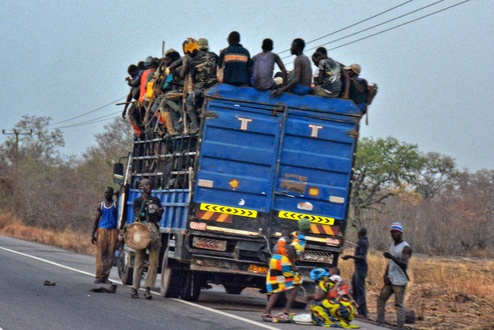
Header photo: Roadside Kumasi to Tamale (Remo Kurka)
Discover More
This remarkable story is only one chapter in the long and often forgotten history of Africa's connections with the wider world. Explore more articles on African kingdoms, Pan-African history, global cultural exchanges and the extraordinary individuals whose lives linked Africa with Europe, Asia and the Americas. Every story opens another door into Africa.